A Bit 'o Random Musings on Politics, Religion, and Anything Else That Passes Through My Crazy Head

Monday, April 18, 2016

#TaxDay2016

In honor of today's U.S. tax filing deadline, here are some interesting articles about taxes that I read in my free time while not doing taxes. I think a lot of this is inside baseball, so you may not find it interesting unless you are also a tax accountant, but I've put a "*" next to the top three articles if you don't want to read all of them.

Wondering why Tax Day is April 18th this year, when it's normally April 15th?  Click Here.

Procrastinators, rejoice - Everyone Files Their Taxes At the Last Minute

Depressing: IRS Service Dramatically Improves to Mediocre (Related: Abolishing the IRS is Stupid, so don't vote for Cruz: Cruz's Plan to Abolish the IRS Would Reward Cheaters*)

More Depressing: How The U.S. Tax System Disadvantages Racial Minorities*

Perspective: No One Ever Died From a Late Tax Return

Lighter "Tax News" from the Onion: Head of IRS Has a Personal Filing System to keep Track of Nation's Tax Returns

The Importance of Disclosure: Every Presidential Candidate Should Release Full Tax Returns (And some Good and Bad Ideas for Tax Plans from the candidates this year)

Taxes Are Important, and ARE About Fairness (and how we define fairness): A Financial Times Columnist...is Wrong*

Why Tariffs Are Bad (and Important): The Case of the Hidden Import Tax

Near and Dear to my SALT-y heart: A Closer Look At The State and Local Tax Deduction

Happy Tax Day! Go Forth and Spend your tax refund however you choose!


Saturday, April 2, 2016

Step Off (Your Own Rameumptom)

Note: this post has been percolating in my mind for a few months, but I haven't yet found the right words to express the concepts I'm trying to convey. So I decided to post anyway, with the hope that you'll understand the spirit of the post, even if I poorly communicate it. 

"School of Rock," starring Jack Black and assorted adorable adolescents, is one of my favorite funny movies. In the movie, Black plays a faux-substitute teacher and out-of-work rock n' roll dreamer who drafts his class into his dream of winning a rock contest.  In one scene, Black and his class compose a song urging everyone to "step off" from bugging them about their lives.


I think of this song when people tell me unpleasant truths. We all have our preconceived notions about ourselves and the world, and when someone shatters those illusions, our first reaction can be to ignore them (both the truths and the person who told them). I can't remember where I first heard of the concept of "white privilege" or "male privilege" or just privilege in general, but I remember being faintly uncomfortable with it. It seemed like people were ascribing my success to something other than my hard work, and somehow blaming me for a system that I didn't control.

A lot of people who benefit from privilege (a) don't realize they benefit, and (b) don't like being told that they benefit from privilege. However, I think there's a good Mormon story that can help people understand privilege, and it's the story of the Zoramites and their Rameumptom (found in The Book of Mormon here). The Zoramites pray a very self righteous prayer, on a platform that they've built to literally put themselves above others, and they cast out the poor from among them. This is a very literal and egregious example of privilege - in this case consciously choosing to reject and think less of others just because of their wealth status.

Reading this, it's obvious to us that the Zoramites are so self-involved they don't even realize they're doing anything wrong. And they are none too happy when Alma and his missionary companions point this out to them. Indeed, "...[the rich Zoramites] were angry because of the word, for it did destroy their craft; therefore they would not harken unto the words" (Alma 35:3). In other words, because the preaching of Alma hurt them financially, the Zoramites were unwilling to change, or even listen to something that would disrupt the status quo.

Privilege is not always so clear cut. Sometimes it is difficult to see that we are standing on a Rameumptom that we did not construct, but that nonetheless gives us a step up on other people. I firmly believe that the antidote to privilege is the empathy and compassion that comes from living the gospel of Jesus Christ. I was reminded of this last week by President Linda Burton's talk, "I Was a Stranger." She shared so many beautiful thoughts, but I was really touched with her call to empathy. She encouraged us to ask ourselves the following question about those in distress: "What if their story were my story?"

I think this empathy is the goal of conversations about privilege. Privilege is not about punishment for those who benefit from the current system, rather it is about helping everyone understand the struggles of those who do not benefit from the current system, in insidious and sometimes very subtle ways. So, I hope that you won't be threatened by discussions of privilege in the future. Instead of telling that person to "step off" and treating this as an accusation about you, consider it an opportunity to step up to listen and learn someone else's story, and understand their challenges.

For a better discussion of privilege, see here.


Thursday, December 31, 2015

The Continent

If I've learned anything about myself over the past few years of blogging, it's if I don't blog about something soon after it happens, it will not get blogged about (see: my Ireland trip a few years ago). Thus, here is a blog post about my epic trip to Budapest and Prague, organized thematically.

As I flew over the Atlantic, I realized it's been about 15 years since I visited continental Europe. This is tragic because, as a history nerd, I love Europe.

Sunrise on the plane - on our way!
Budapest and Prague were both unique - I felt like Prague had more of an classical European "old world" feel, while Budapest was more funky and eclectic.
Hanging out with my fellow American, Ronald Reagan, in Budapest
Budapest has lots of random statutes - we saw Imre Nagy, Ronald Reagan, Attila Jozsef, Lajos Kossuth, the Magyar kings, St. Gellert, Queen Elisabeth (of Austria-Hungary, not the one you're thinking of), along with anonymous statutes of 19th century policemen and 20th century guitar players. Lady Liberty of Budapest graces the city and is visible almost everywhere. Prague had Kafka randomness, St. John of Nepomak, Tycho Brache and Johannes Kepler, and a bridge full of statues that I wish I knew more about.

Dohany Street Synagogue, Budapest
Each city had some beautiful cathedrals, churches, and synagogues. I love the feel of cathedrals - awe-inspiring and huge, with beautiful art reminding us of divine truths. In Budapest, we saw St. Stephen's Cathedral, and marveled at the scenes of the city from the top of its dome. The Rock Church was a small chapel built into the hillside on the "Buda" side of the river. Budapest had the beautiful Dohany Street Synagogue, ornate in its decorations and even boasting an organ (Orthodox synagogues don't have organs, as this would require someone to "work" on the Sabbath by playing the organ). Budapest's Rumbach Street Synagogue was a beautiful example of Moorish architecture, but sadly, much in need of repair. I loved the multi-colored tiles of the Matthais Church high on Buda hill, which also boasted a very colorful (painted) interior.
Matthais Church, Budapest - love the gingerbread multi-colored roof tiles!

St. Vitus Cathedral. Just, you know, AMAZING.
In Prague, St. Vitus Cathedral was massive, mighty, and magnificent. I especially loved a stained glass window done by Alphonse Mucha. St. Nicholas Church in Prague was way too much Baroque (I can only take that style in small doses). We also took a day trip to Kutna Hora outside Prague to see the Bone Church Ossuary (CREEPY - just really really really CREEPY) and St. Barbara's Cathedral. I liked that St. Barbara's was not very crowded and had some interesting history, being in a former silver mining town. Prague's Jewish quarter held a very simple and very old synagogue built in the 13th century (!), along with the beautiful moorish designed Spanish Synagogue. Tyn Church was old and stately, with great accoustics.
Budapest Opera House - Grandiose and AWESOME! 
This trip was filled with lots of great music in great venues. We attended an Opera in Budapest's Opera House. The Grand Staircase reminds me of the staircase in the Titantic movie (my reference points are super classy like that). The opera was in French with Hungarian/English surtitles and it was Werther, based on a German novel - how's that for multi-cultural! We went to a charity concert performance of Mozart's Requiem at St. Matthais in Budapest - the music just seemed to expand and fill every nook and cranny of the cathedral. In Prague, we went to a concert in the Tyn church, which was basically the "greatest hits" of classical music and totally geared towards tourists like me, but it was still amazing to hear "Ave Maria" belted out in a cathedral that's stood for hundreds of years. Our last night in Prague, we hit a high note by attending a concert which was part of the "Strings of Autumn" series. The concert featured songs in french with absolutely perfect and amazing piano accompaniment (the one song I recognized was Claire De Lune, which I only recognized because it's in Ocean's Eleven...like I said, classy). The best part, however, was the venue - an opulent and absolutely perfect hall in Prague castle.
Spanish Hall, Prague Castle
Speaking of amazing spaces, we toured the Budapest Parliament building, which was stunningly gorgeous and super interesting. In Prague, we visited two gorgeous libraries at the Strahov Monastery and Klementium. We also wandered along Charles Bridge several times, which may have been my favorite place in Prague - stunning views of the Prague skyline and lots of people enjoying the scene, selling artwork and crafts, and looking at the statutes.

Strahov Monastery Library, aka my personal reading room if I was a Billionaire
In Budapest we visited the House of Terror, used by the secret police under both the Nazi and Soviet regimes. It is a reminder of the pain and suffering that too many still face at the hands of political oppression. Much as I don't like some of the presidential nominees this election season, I don't think any of them would go that far (hopefully we all won't have to find out).
Budapest Holocaust Memorial
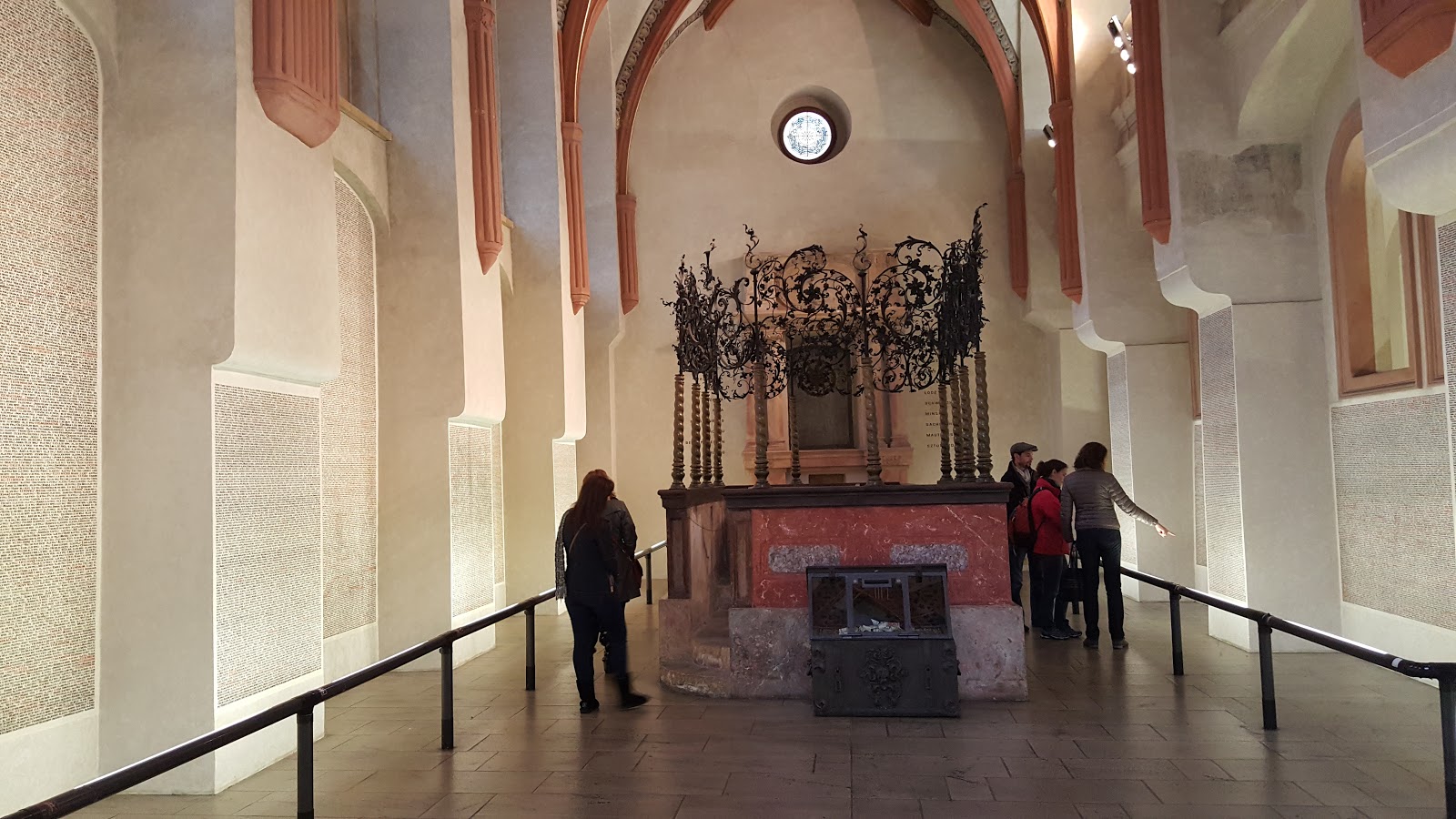
Both cities had sobering reminders of the tragedies of the Holocaust. In Budapest, we saw the Holocaust memorial on the side of the Danube. This memorial was fashioned out of cast iron shoes, to remember those who lost their lives at the hands of the Arrow Cross militia.  Jews were ordered to take off their shoes before being shot and having their bodies carried away by the river. On Budapest synagogue grounds, there was also a metal tree with leaves holding the names of those lost in the Holocaust. In Prague, the Pinkas synagogue has the names of all the Jewish victims of the Holocaust from Bohemia and Moravia - it was sobering and terrifying to think that human beings could do that to other human beings. Budapest and Prague both had Jewish Ghettos where Jews were essentially imprisoned even before being shipped off to work camps or concentration camps in other locations.
Pinkas Synagogue
Along with the Holocaust memorials, there were reminders that some people tried to help. We saw monuments to Carl Lutz and Raoul Wallenburg, European diplomats who helped save thousands of Jews in Budapest. One of the things I love about traveling is learning about historical figures. I was really impressed with the story of Jan Hus, a Czech reformationist pastor who was killed at the hands of the Catholic Church for standing up for his beliefs, which included arguing for the right of all people to take communion and hear church services in their native tongue.

Jan Hus, one of my new heroes
Of course, we ate lots of yummy and varied food - I tried to be adventurous, but I probably didn't try anything too exotic because I fear sickness and I'm a wimp. Lantos, or fried bread, was a delicious and filling meal in Budapest. Pinterest clued us in to Gelato Rosa in Budapest, a gelato place with ice cream cones shaped like roses (for the record, the gelato was scrumptious as well as visually stunning). A Jewish bakery in Budapest had lots of pastries. Our best meal was undoubtedly at Strudel House in Budapest, where we had goulash, savory and sweet strudel, raspberry soup, and fresh bread. Also had a delicious meal at Cafe Louve in Prague, complete with bread dumplings. We ate lots of snack and street food - Turo Rudi (sweet cottage cheese covered in chocolate), potato chips on a stick, Kurtoskalacs (a spiral hollow bread originally from Hungary - in Prague we had some filled with ice cream that were DIVINE). Filed under random: pizza with duck!
Lantos with sour cream, ham, lettuce, and cheese - YUM!
The guidebooks all said that one of the "must" experiences in Budapest was the public baths. We visited the Szechenyi Baths, where we enjoyed warm mineral water along with water jets, a circular lazy river, old guys playing chess, and of course, men wearing speedos. We also rode the funicular in Budapest, a little jaunt up the hill, and climbed all over the Buda side of the river, enjoying the Changing of the Guard, the art museum, and great views of the flat "Pest" side of the city.
Why yes, that is a man playing chess at the Public Baths in Budapest!
Another "must" was the Astronomical Clock in Prague - it's a beautiful marvel of medieval engineering with lots of moving figures. Some think it's over-rated, but I enjoyed watching the figures move and being part of the tourist crowd. We also did a night-time cruise along the Vltava river in Prague, and it was lovely to see the city at night. In Prague we got our fill of art by seeing both the Slav Epic and the Mucha Museum. The Slav Epic is a collection of massive (and I do mean HUGE) canvases completed by Alphonse Mucha to celebrate Slavic history. I loved the ones showing preaching by Jan Hus and also a Russian scene of St. Basil's cathedral. 
Pretty Cool Clock, eh?
We walked everywhere, and enjoyed some crisp fall weather and only a bit of rain. It was wonderful to be outside, away from work, and enjoying the delights of two classic European cities. Extra wonderful was sharing the experience with two good friends! A line from the opera we saw has stuck with me: "God wants us to be happy!" (sung at the end, and if you know how Werther ends, you'll appreciate how ironic that is). I really do believe that God wants happiness for all of us, and I hope that 2016 brings all of you much happiness and joy!  Happy New Year!

Friday, October 23, 2015

October Optimization

This particular Molly Mormon Democrat can't bring herself to blog about politics when a certain Orange-American is leading in polls for the Republican nomination. When the electorate comes to its senses, she'll be back in the stateship saddle.  In the meantime, here is a post about one of her other loves, Autumn.


Last weekend I spent two days hiking and glorying in the beauties of Virginia autumn along Skyline Drive in the Shenandoah. I spent most of the time alternating between reciting/composing poetry, and laughing at my pretentiousness for reciting/composing poetry. Here are some of my pictures, poems I half remembered during my rambles, and at the end, one of the poems I composed as I hiked (apologies in advance).  If you need a soundtrack to listen to while reading, might I humbly suggest Eva Cassidy's Falling Leaves?


Dark hills against a hollow crocus sky
Scarfed with its crimson pennons, and below 
The dome of sunset long, hushed valleys lie
Cradling the twilight, where the lone winds blow 
And wake among the harps of leafless trees 
Fantastic runes and mournful melodies. 

The chilly purple air is threaded through
With silver from the rising moon afar, 
And from a gulf of clear, unfathomed blue
In the southwest glimmers a great gold star 
Above the darkening druid glens of fir 
Where beckoning boughs and elfin voices stir. 

And so I wander through the shadows still,
And look and listen with a rapt delight, 
Pausing again and yet again at will
To drink the elusive beauty of the night, 
Until my soul is filled, as some deep cup, 
That with divine enchantment is brimmed up. 

(An Autumn Evening, L.M. Montgomery)


Let the mountains shout for joy, and all ye valleys cry aloud; and all ye seas and dry lands tell the wonders of your Eternal King! And ye rivers, and brooks, and rills, flow down with gladness. Let the woods and all the trees of the field praise the Lord; and ye solid rocks weep for joy! And let the sun, moon, and the morning stars sing together, and let all the sons of God shout for joy! And let the eternal creations declare his name forever and ever! 

(Revelation to the Prophet Joseph Smith, canonized in 
Mormon scripture as Doctrine & Covenants 128:23)


The leaves are falling, falling as if from far up,
as if orchards were dying high in space.
Each leaf falls as if it were motioning "no."

And tonight the heavy earth is falling
away from all other stars in the loneliness.

We're all falling. This hand here is falling.
And look at the other one. It's in them all.

And yet there is Someone, whose hands
infinitely calm, holding up all this falling. 

(Autumn, Rainer Maria Rilke)


O world, I cannot hold thee close enough!
Thy winds, thy wide grey skies!
Thy mists, that roll and rise!
Thy woods, this autumn day, that ache and sag
And all but cry with colour! That gaunt crag
To crush! To lift the lean of that black bluff!
World, World, I cannot get thee close enough!

Long have I known a glory in it all,
But never knew I this;
Here such a passion is
As stretcheth me apart,—Lord, I do fear
Thou’st made the world too beautiful this year;
My soul is all but out of me,—let fall
No burning leaf; prithee, let no bird call.

(God's World, Edna St. Vincent Millay)


The name—of it—is 'Autumn'—
The hue—of it—is Blood—
An Artery—upon the Hill—
A Vein—along the Road—

Great Globules—in the Alleys—
And Oh, the Shower of Stain—
When Winds—upset the Basin—
And spill the Scarlet Rain—

It sprinkles Bonnets—far below—
It gathers ruddy Pools—
Then—eddies like a Rose—away—
Upon Vermilion Wheels— 

(The Name-of it-is 'Autumn,' Emily Dickinson)


Go, sit upon the lofty hill,
And turn your eyes around,
Where waving woods and waters wild
Do hymn an autumn sound.
The summer sun is faint on them —
The summer flowers depart —
Sit still — as all transform’d to stone,
Except your musing heart.

How there you sat in summer-time,
May yet be in your mind;
And how you heard the green woods sing
Beneath the freshening wind.
Though the same wind now blows around,
You would its blast recall;
For every breath that stirs the trees,
Doth cause a leaf to fall.

Oh! like that wind, is all the mirth
That flesh and dust impart:
We cannot bear its visitings,
When change is on the heart.
Gay words and jests may make us smile,
When Sorrow is asleep;
But other things must make us smile,
When Sorrow bids us weep!

The dearest hands that clasp our hands, —
Their presence may be o’er;
The dearest voice that meets our ear,
That tone may come no more!
Youth fades; and then, the joys of youth,
Which once refresh’d our mind,
Shall come — as, on those sighing woods,
The chilling autumn wind.

Hear not the wind — view not the woods;
Look out o’er vale and hill —
In spring, the sky encircled them —
The sky is round them still.
Come autumn’s scathe — come winter’s cold —
Come change — and human fate!
Whatever prospect Heaven doth bound,
Can ne’er be desolate.

(The Autumn, Elizabeth Barrett Browning)


O hushed October morning mild,
Thy leaves have ripened to the fall;
Tomorrow’s wind, if it be wild,
Should waste them all.
The crows above the forest call;
Tomorrow they may form and go.
O hushed October morning mild,
Begin the hours of this day slow.
Make the day seem to us less brief.
Hearts not averse to being beguiled,
Beguile us in the way you know.
Release one leaf at break of day;
At noon release another leaf;
One from our trees, one far away.
Retard the sun with gentle mist;
Enchant the land with amethyst.
Slow, slow!
For the grapes’ sake, if they were all,
Whose leaves already are burnt with frost,
Whose clustered fruit must else be lost—
For the grapes’ sake along the wall.
(October, Robert Frost)


Nature’s first green is gold,
Her hardest hue to hold.
Her early leaf’s a flower;
But only so an hour.
Then leaf subsides to leaf.
So Eden sank to grief,
So dawn goes down to day.
Nothing gold can stay.

(Nothing Gold Can Stay, Robert Frost)


Downhill, is glorious 
A shouted hymn of praise towards
Nature, and nature's God.

Uphill, is terrible
A whispered curse of labored 
Ragged breath.

Down, Up, Down, Up, 
Mingling the praise and curses
Amidst crunching leaves.

Honey gold to crimson red,
Leaves spiral in the wind
Pulling me down the path.

Grateful, I remember the wonder that is 
My body - this flawed, strong thing.
Its imperfections still allow me to ascend.

I wonder, wandering
If the poet's right, that 
"Nothing gold can stay."

Perhaps, if I leave my doubts, anxieties,
misgivings, to sit and mellow,
They will change to gold.

Then turn to brown, and fall, 
Winter's carpet, preparing
The way for new beginnings.

What will grow? 
If I let those things be? 
Leave them to turn to mulch.

Waiting, still and silent, for spring life.
What will grow? If I am patient?
I suppose it will depend on what I plant.
(Hiking, Me)


There's something ultimately magical about being alone in the forest, and breathing in the glories of nature.  I know I romanticize it, but I really do feel renewed and refreshed while I hike.  Which makes it that much harder to leave when it's over.  Thus, the frowny face when I leave the park behind:


Optimize your October - go outside and enjoy Autumn!


Sunday, September 6, 2015

Kim, Gavin, and Martin: Breaking the Law to Save It

Where did August go? Lately my goal has been to blog once a month, but August was a total fail on that score. Here's to recommitting for fall!

The news these days has been abuzz with stories about Kim Davis, the Kentucky county clerk who has refused to issue marriage licenses and been unwilling to comply with the recent U.S. Supreme Court decision authorizing gay marriage everywhere in the United States. To some she has become a hero of the right to religious freedom, to others she is a pariah of backwardness.

As Mrs. Davis has been in the news, I couldn't help but think of Gavin Newsom. In case you've forgotten, Mr. Newsom was mayor of San Francisco several years ago, and in 2004 he directed his city clerks to issue marriage licenses to gay couples, in violation of California state law at that time. In a sense, he is the anti-Kim Davis.

It's interesting to me that your position on gay marriage likely colors how you view both Mr. Newsom and Mrs. Davis, even though they are both doing the same thing - breaking the law because it violates their moral principles. It's also interesting that both individuals have expressed a strong sense of faith (Mr. Newsom is Catholic, Mrs. Davis is a self-described Apostolic Christian). These individuals have reminded me of one of our country's most famous law breakers in the name of religion and conscience: Martin Luther King.

Dr. King's "Letter From Birmingham Jail" remains one of the best explications of breaking the law to save it that I've ever read (and it's probably a better use of your time to read it than this blog post). Here's an excerpt that I thought applied to the current situation:

One who breaks an unjust law must do so openly, lovingly, and with a willingness to accept the penalty. I submit that an individual who breaks a law that conscience tells him is unjust, and who willingly accepts the penalty of imprisonment in order to arouse the conscience of the community over its injustice, is in reality expressing the highest respect for law.

How then do we determine which laws to follow and which to break? Dr. King writes:

An unjust law is a code that a numerical or power majority group compels a minority group to obey but does not make binding on itself. This is difference made legal. By the same token, a just law is a code that a majority compels a minority to follow and that it is willing to follow itself. This is sameness made legal. Let me give another explanation. A law is unjust if it is inflicted on a minority that, as a result of being denied the right to vote, had no part in enacting or devising the law.

Thus, if the presidential candidate I support loses the election, and I had a right to vote and participate in the democratic process behind that, I still have to obey the laws signed by that president. This gets trickier, though, in light of a Supreme Court decision that was not made by democratically elected leaders. One of the main arguments of the anti-gay marriage groups seems to be that the Supreme Court cannot make laws, as they were not democratically elected. I've been disturbed by some of this rhetoric, as it could lead to a lack of respect for U.S. Supreme Court decisions that we disagree with. But I think this goes back to what Dr. King said about the law binding everybody - the majority and the minority.

For example, the marriage licenses issued by Gavin Newsom's clerks were ultimately invalidated by the California courts. In other words, the law should apply equally to everyone - if you believe the law is unjust, work hard to change the law, and be willing to accept the penalties of breaking the law. Current polls suggest that most Americans support gay marriage (55% according to the Pew Research Center's data). How do we square that with peoples' religious beliefs on gay marriage? I think we are all still working that out.

In typical me fashion, I hope we can have respect for both the Gavin Newsoms and Kim Davises of the world. They are doing right as they see the right. Further, they are my brothers and my sisters. My duty is to love them and seek to understand them rather than demonizing them or belittling their sincerely held beliefs. I close with some more of the words of another brother, Dr. King, who asks us some important questions.

But though I was initially disappointed at being categorized as an extremist, as I continued to think about the matter I gradually gained a measure of satisfaction from the label. Was not Jesus an extremist for love: "Love your enemies, bless them that curse you, do good to them that hate you, and pray for them which despitefully use you, and persecute you." Was not Amos an extremist for justice: "Let justice roll down like waters and righteousness like an ever flowing stream." Was not Paul an extremist for the Christian gospel: "I bear in my body the marks of the Lord Jesus." Was not Martin Luther an extremist: "Here I stand; I cannot do otherwise, so help me God." And John Bunyan: "I will stay in jail to the end of my days before I make a butchery of my conscience." And Abraham Lincoln: "This nation cannot survive half slave and half free." And Thomas Jefferson: "We hold these truths to be self evident, that all men are created equal . . ." So the question is not whether we will be extremists, but what kind of extremists we will be. Will we be extremists for hate or for love? Will we be extremists for the preservation of injustice or for the extension of justice?


Friday, July 3, 2015

(Un) American Heroes

I read an article many years ago (either in the Bloggernacle or maybe BYU's Political Review) which talked about the futility of comparing the society in the Book of Mormon to our modern day politics because of the vast differences in our society. While I didn't agree with all of it, it's certainly a valid point that the largely agrarian and tribal society in the Book of Mormon is vastly different than our industrialized democratic republic here in the U.S.

One example of this is Captain Moroni, who is a hero in the Book of Mormon's war chapters. Mormon, the editor of the Book of Mormon, shows Captain Moroni some serious love when he writes: "Yea, verily, verily I say unto you, if all men had been, and were, and ever would be, like unto Moroni, behold, the very powers of hell would have been shaken forever; yea, the devil would never have power over the hearts of the children of men" (Alma 48:17). Mormon obviously thought Moroni was a hero, and portrayed him as such. With all that, it's no surprise that Mormon named his son Moroni, and generations of church members have looked to Captain Moroni as the paragon of virtue and righteousness.

But if we look closely at the record, Captain Moroni is in some ways a dangerous example to promote when we talk about current political affairs. He executed people who didn't agree with him (Alma 46:34-35, 51:14-20). He also had a vast impatience with anyone who didn't do exactly what he wanted when he wanted it (see Alma 60). In many ways, Captain Moroni saw the world in very black and white terms, which is useful if you're fighting an enemy that wants to kill you and drink your blood, but isn't very useful if you're trying to take part in a democracy where people will disagree with you.

Looking at modern day politics through Captain Moroni's lenses will cause us to see people as traitors if they disagree with us about political affairs. Captain Moroni threatened to lead an insurrection if the government didn't do what he wanted (Alma 60:27), even if the majority will disagreed with his policies, all the while claiming ironically "... I seek not for power, but to pull it down." (Alma 60:36). By seeking to "pull down" those leaders who didn't agree with his worldview, Captain Moroni was like an ancient version of Douglas MacArthur during the Korean war - critical of government policy and seeking to impose his military views on the political leaders of his time.

In America we believe in a secular society where military power is controlled by the civilian branches of government. We also separate government and religious action in order to allow all mankind to "...worship how, where, or what they may" (11th Article of Faith). These concepts would be foreign to Moroni and many in the Book of Mormon, who viewed government and religion as necessarily intertwined, and would likely not appreciated the checks and balances of the American political system. As I've stated before here, and for the reasons laid out much more eloquently here, I believe it's a good thing that America has religious freedom while also strictly separating church and state.

Ultimately, I believe the Book of Mormon teaches us very valuable principles. These principles can be applied differently by different people, and it's only right that in a society based on freedom we argue and debate the priority of various principles and how they apply to various situations. But to use a military leader from thousands of years ago as a political paragon ignores some of the more troubling aspects of his leadership. Hero worship is never a good thing, because humans are fallible and imperfect beings. And what I love about American government is that it recognizes this, and builds in checks and balances to guard against the imperfections in our temperaments.

We're still building America, as this one supremely idealistic scene from the TV show The West Wing reminds us:

Jeff Breckenridge: You got a dollar?
Josh Lyman: Yeah.
Jeff Breckenridge: Take it out. Look at the back. The seal, the pyramid, it's unfinished, with the eye of God looking over it, and the words annuit coeptis - he, god, favors our undertaking. The seal is meant to be unfinished, because this country's meant to be unfinished. We're meant to keep doing better. We're meant to keep discussing and debating. And, we're meant to read books by great historical scholars and then talk about them...
So, study Captain Moroni - be bold and valiant like he was, that's a good thing. But realize that some of his values were un-American, even if he is a hero, and keep building the America you want to see, with empathy for those who disagree and a respect for our constitutional system which guards your liberties, my liberties, and the liberties of all who live here.

Happy Independence Day!


Sunday, May 31, 2015

Grinding the Faces of the Poor, and Other American Political Bloodsports

What mean ye that ye beat my people to pieces, and grind the 
faces of the poor? saith the Lord God of Hosts. (Isaiah 3:15)

Nothing makes me angrier than politicians who disparage poor people. It's an easy target, because poor people don't often vote, protest, or communicate with their elected officials. It's a simple way to show you are using government funds sparingly - making sure "undeserving" poor aren't using welfare funds to buy lobster or go a cruise.

The latest example is Kansas, which has recently enacted a law limiting the amount of cash which welfare recipients can withdraw from ATMs and forbidding welfare recipients from spending money on "exotic" entertainment, swimming pools, tattoos, or movies. Even more states are moving to drug test welfare recipients, even though the evidence shows these groups are not more likely to abuse drugs than the population at large. Similarly, government assistance with housing costs disproportionately goes to the mortgage interest deduction for the upper/middle class instead of housing vouchers for those in a lower socioeconomic status.

So, here are my reasons why we need to stop abusing the poor for using government benefits:
1) People using government benefits don't actually spend a large portion of their money on extravagances. Their spending habits aren't actually all that different from the rich or the middle class.
2) There's a myth that the poor are sponging off the rest of us taxpayers, but the truth is that poor people pay taxes too - in some cases more taxes than the rich. Further, government benefits do not allow you to live the high life, as reading this article will show you, people receiving welfare are hardly rich, and often only need temporary assistance to get through the lean times. They're you and me, not some "second class" of citizens who we can mock and disparage.
3) We all receive government benefits, and that doesn't give the government the right to tell us how to live our lives. Should the hedge fund manager be required to stop visiting a strip joint because he claims the mortgage interest deduction on his tax return? (In some cases for both his primary residence and vacation home?) What about the student who receives a low interest loan yet gets a tattoo? These are government benefits, just like food stamps, yet apparently it's okay for Kansas to tell welfare recipients how to spend their money, or for states to invade these people's privacy through requiring drug testing, but the government makes no similar provisions for the other benefactors of government largess.

Isaiah uses strong imagery to condemn those who trample the poor - they "grind their faces" - can you imagine if someone literally did that?  That's assault! Yet it's okay for politicians to condemn these people and figuratively grind their faces into the dust. This is political bloodsport, and IT IS WRONG. It makes me so very sad to think that this is acceptable behavior by politicians, who should be seeking to help these people lift themselves out of poverty, instead of stereotyping them and making life more difficult for them.