A Bit 'o Random Musings on Politics, Religion, and Anything Else That Passes Through My Crazy Head
Showing posts with label Femme Fatale Feminist. Show all posts

Thursday, May 5, 2022

The (GOP-Court-Majority-Sized) Elephant in the Room

Unless you've been living under a rock the past few days, you probably heard that a leaked Supreme Court decision shows a majority on the Court are supporting an overturn of the precedential case Roe v. Wade, which provided a constitutional right to abortion in certain cases. While most observers expected this conservative majority to chip away at abortion rights, the main shocking thing seems to be that Roe is being completely thrown away (and under reasoning I find very suspect, but that's probably a separate post). 

I believe that one of the reasons many Mormons are so Republican/conservative is that there is a strong anti-abortion sentiment among most members. In case you haven't already guessed this from the title of my blog, I'm pro-choice (and I did another blog post on this topic back in 2013). That doesn't mean I necessarily think abortion is great. If I found myself with an unwanted or unplanned pregnancy, I know I would really struggle with what to do - but I think it should be my choice, not the government's. It seems like the height of government overreach to say that government should control the private medical decisions about what happens inside a woman's body. So, I thought I would lay out the "moral" and "practical" reasons I feel that abortion should still be legal here in America.

The Moral Argument for Legal Abortion

If someone needs a kidney transplant, I cannot be forced to give him/her my kidney - even if I *can* do so without causing my own death, the law of the land respects my bodily autonomy enough to say that I cannot be forced to save another's life. Is this a morally complicated issue? Absolutely! But I have control over how my body is used - that is the essence of personal liberty. The same argument applies to abortion. Not even a mother can be forced to save the life of her child by giving up a kidney - similarly, I don't believe a woman should be forced to carry a baby to term.

There are many circumstances where a woman may consider an abortion - when her own life is at stake, when the baby's life is at stake, when the pregnancy is the result of rape/incest, or many other situations too numerous to mention. My point here is that the woman is an adult, capable of making mature ethical and medical decisions. You may not agree with those decisions (just like you might not agree with me eating junk food) but you don't get to make those decisions on behalf of another person. 

Of course, pro-life individuals will argue that it is the woman who is making a decision on behalf of another person by "murdering" a fetus. To me, the question of when life begins is a complicated one - is a fertilized egg sitting in a petri dish, waiting to be implanted in a woman, a life? I don't think so, and most people would agree that it's not. On the other hand, I don't believe that abortion should be allowed "up to conception" - at some point, that fetus becomes a baby, and I'm not sure when that is, to be honest. BUT, I know that I am much more comfortable with women making a decision on abortion, than with a court mandating that women be forced to give birth.

Practical Arguments for Legal Abortion 

Setting aside the moral arguments for and against legal abortion, let's look at the practical arguments.

Research shows that rates of abortion are similar across the world in countries where abortion is legal and where it is illegal. Outlawing abortion doesn't decrease the number of abortions, it decreases the number of safe abortions. One of the consequences of overturning Roe will be women seeking unsafe abortions, and likely dying as a result. How can you claim to be pro-life if the policy you are pursuing results in more death?

The majority of Americans think that abortion should be legal in some or all circumstances. The most recent poll I could find showed that 32% of Americans think abortion should be legal in all circumstances while 48% said it should be legal in some circumstances - only 19% of Americans think it should be illegal in all circumstances (poll info along with lots of other polls available here). How are we going to craft laws that allow abortion in the cases where most people believe it should be legal (i.e. mother's health at stake, or as the result of rape) while disallowing it in cases we think it shouldn't be legal? It's really hard to draft a law considering all situations, and it's also going to be really hard to enforce that law. Are we willing to lock up women seeking abortions? Send doctors and medical professionals to jail? Do we think that these actions are the right answer here? 

Final Thoughts

Look, you may agree with none of what I said (in which case, kudos for reading this far). That is okay - there are lots of different views on abortion, and it's a complicated moral issue, so there should be lots of different views. But, I would ask you to step into the shoes of women contemplating abortion - think about the 11-year old victim of rape, the mother of 3 who finds out her baby has a non-survivable medical condition, the woman finding out that a longed-for pregnancy is dangerous to her health, the abuse victim who can't bear to raise a baby with her abuser. There are a lot of these stories out there. You may not think that these situations represent the majority of those seeking abortions, but there are a non-zero number of stories like this. Please have compassion on the women in any situation where they are contemplating abortion, and consider them as people, as human beings with thoughts and emotions and their own unique circumstances. I think they are able to make this difficult decision best for themselves, rather than having it made for them by the government.

There is lots more I can say on this topic - all the ways we can reduce "demand" for abortions without outlawing "supply," etc. But for now, I'll leave you with this clip from the movie "After Tiller" about late term abortions - this clip is about a fetus developing without part of its brain, and the difficult decision facing the doctor and parents at a late stage of pregnancy. I think about this clip a lot when abortion is discussed. I hope that no one has to go through this agonizing decision, but the only thing that could make it worse is if the government intervened and made the decision for you.

<iframe width="560" height="315" src="https://www.youtube.com/embed/l9-tTrbjmyw" title="YouTube video player" frameborder="0" allow="accelerometer; autoplay; clipboard-write; encrypted-media; gyroscope; picture-in-picture" allowfullscreen></iframe>

Wednesday, August 25, 2021

Road Trip Part 1: Suffrage Sites

Hi Y'all! As you have seen, I have not posted much regarding my sabbatical - unfortunately I have spent most of it reading silly books and procrastinating important decisions. But, a week ago I set out on my epic road trip - covering thousands of miles and practically a whole continent! 

On my way to the main attractions (Glacier, Yellowstone, and Grand Teton National Parks), I stopped at a few suffrage historical sites along the way. As you all know, I'm a huge nerd for suffrage history, and I've organized/led suffrage walking tours of Washington, DC covering the involvement of Mormon women in the suffrage movement. So, without further ado, here are some pictures and details of the suffrage sites I visited. I'm currently debating whether I want to spend the money to stay in the very ritzy Hermitage Hotel in Nashville, where the suffragists plotted their campaign to get Tennessee to ratify the 19th amendment (Tennessee was the final state they needed to ratify so that women could vote in the 1920 election). 

Harriet Taylor Upton's Home in Warren, Ohio

It's a safe bet that most of you haven't heard of Harriet Taylor Upton, but she was an instrumental figure in the women's suffrage movement. She was treasurer of the national suffrage association for over 15 years, and for a period close to a decade, the national association's headquarters was in her hometown of Warren, Ohio so she could run the office. Harriet was also big in Republican party politics, as her father was a congressman. In her (huge) dining room in (tiny) Warren, OH, Harriet entertained 4 Republican presidents. During the 1920 campaign, Harriet was the one who held Warren G. Harding's feet to the fire and made sure he did everything he could for suffrage (at the time, she was the highest ranking woman in the Republican party). 


Harriet's House!

The house was nice and well maintained by a local Harriet Taylor Upton society (they rent it out for events). While there, I bought a copy of Harriet's "Random Recollections" - some of her memories. I wish she would have written more about her suffrage activities - she barely mentions her treasurer duties, and as an accountant, I am professionally interested. But here are a few of my favorite moments:

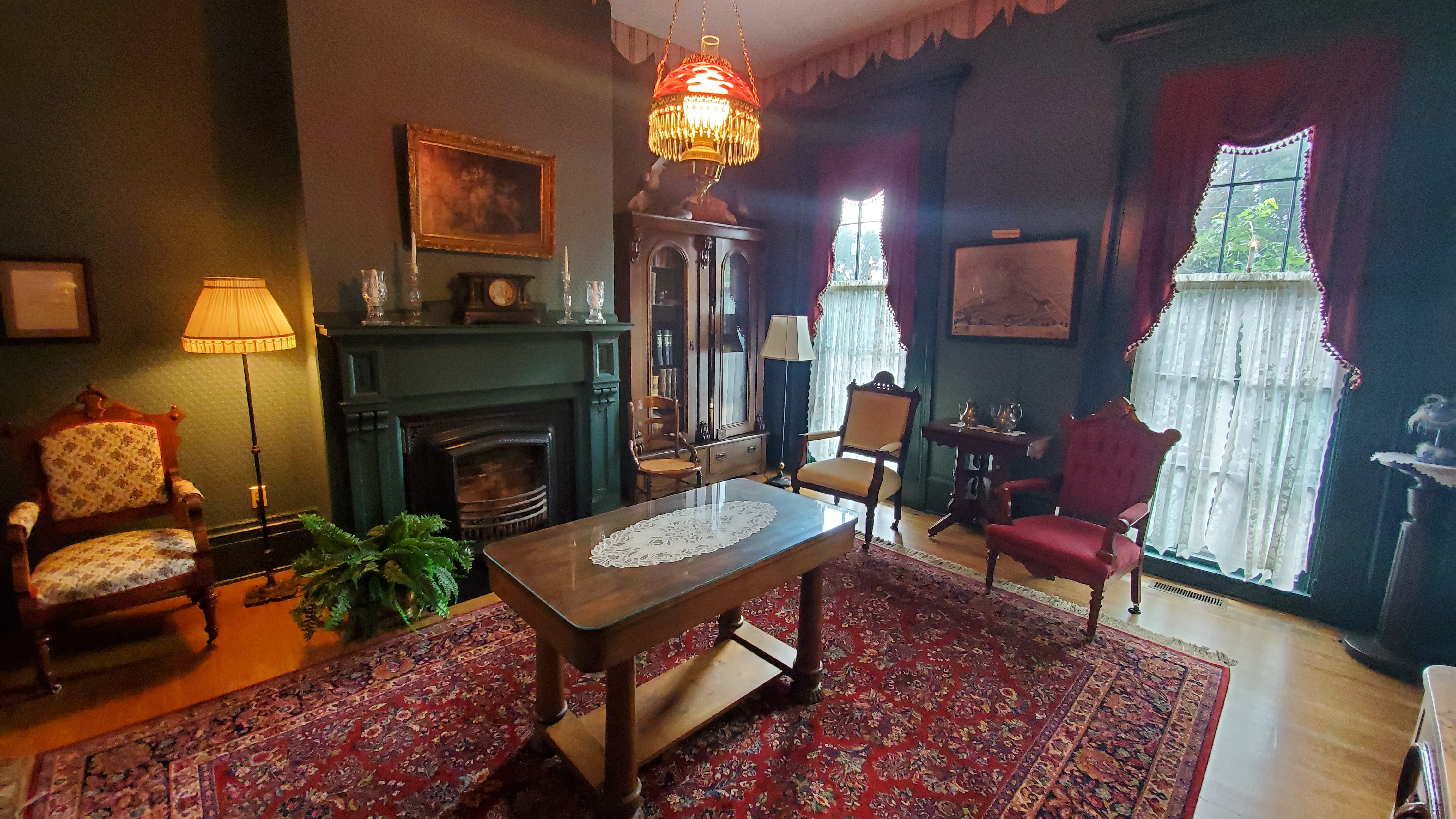
Harriet's huge dining room. I swear you could probably seat 30 people comfortably in this room.

- She woke up Carrie Chapman Catt in the middle of the night so that CCC could help re-enact a funny story Harriet was telling to the other suffragists traveling with them. Harriet was renown for her sense of humor and ability to make people laugh. (pg. 113)

Harriet's study, which displayed letters she wrote and received from Republican Presidents, including Calvin Coolidge

- She noted that women had to be "politicians before they were voters." Her memoirs are full of trenchant political analysis that still applies today. "Legislators may be leaders, but more often they seem to be followers." (pg. 106) Writing of an episode where one senator encouraged her to make up stories about another senator to blackmail him to the suffrage cause, she writes: "Why do sensible people put fools - really mentally lacking fools - in office?" (pg 144)

- She was in the congressional gallery with Susan B. Anthony when Wyoming was accepted as a state, with women enshrined as voters in that state's constitution. Susan B. Anthony said to her "it is the beginning of the end." (pg 107) I have to admit I teared up a bit at that.

- In describing Elizabeth Cady Stanton, she said "She was humorous, logical, and an agitator. She loved to stir up things, leaving the straightening out to Miss Anthony. She was not an organizer. The agitator in any reform precedes the organizer." (pg. 93)

- Speaking of her battle to get Tennessee Republicans to ratify the 19th amendment, she said: "I was to trust them and encourage them and keep calm if possible (it was not possible). And to be hopeful and happy if possible (and it wasn't possible)." 

Harriet's ashes are buried in her garden - she loved gardening.

If you're interested in learning more about Harriet, there are two really short episodes of the Mercantile Library's Podcast "Genius of Liberty" which talk about Harriet and her contributions - see episodes 9 and 10 (the whole podcast is great - lots of interesting suffrage history nuggets in short bursts!).

Sojourner Truth - Statute (Battle Creek, MI) and Plaque (Akron, OH)

Sojourner Truth is probably someone you already know, but did you know she fought a court case for her children's freedom after they were illegally sold down south? She was also a powerful speaker on behalf of abolition and women's rights. She gave her famous "Ain't I a Woman?" speech in Akron, OH, and there is a plaque there memorializing where it happened. Kerry Washington performed part of Sojourner's speech in this video. There is some controversy over whether the text was modified, as the most famous version of the speech was written down many years after the convention where Sojourner spoke. Currently, money is being raised to erect a statue of Sojourner on this site - you can donate here if you are interested.

Plaque where Sojourner gave her 1851 speech in Akron, OH

Sojourner spent the last years of her life in Battle Creek, Michigan, and there is a 16 foot high statute of her there. She's also buried there, but I didn't get to see her grave as the cemetery was closed the day I was there. You can learn more about Sojourner in this TED Video - I appreciated especially her faith in God.

Sojourner's Statute in Battle Creek, MI

Ida B. Wells-Barnett Home, Chicago, Illinois

Today this is just someone's private residence, but for over a decade in the early 20th century, this stone townhouse in Chicago (near the White Sox stadium) was home to one of the 19th and 20th century's fiercest anti-lynching writers, who was also a suffragist. Ida B. Wells-Barnett is just an amazing lady, and I was glad I could stop by her house and remember her amazing contributions. If you're interested in learning more about her, this podcast episode was really good.

Ida's Chicago Home

Frances Willard's Home, Evanston, Illinois

Not far away from Ida's home, just north of Chicago, was the home of another legendary progressive activist, Frances Willard. Frances was the head of the Women's Christian Temperance Union (WCTU) for decades. Her home is now a museum with many of her belongings still there. This tour was really good - the docent leading the tour knew so much about Frances and was able to answer all my questions, I was really impressed - it helped that it was a tour just for me and their new intern.

Frances' "cottage" in Evanston

Frances urged WCTU members to get involved in politics and suffrage. The tour noted that the WCTU got many more conservative women into the movement - the WCTU was a respectable way for women to become more involved in political matters and served as a "gateway drug" to more progressive and radical reforms. For more info you can check out this online essay and this online exhibit. The museum also has an online exhibit about the clash between Frances Willard and Ida B. Wells-Barnett - Ida called out Frances on her racism.

Actual photo of Frances at work - she wasn't afraid of clutter!

Frances' Study - much neater than in life!

While there, I purchased a short book by Frances: "How I Learned to Ride the Bicycle." It was a fun little book (her part was only 80 pages), but there were also some interesting scholarly essays talking about the context of women riding bicycles in the 19th century, which was fascinating.

Frances named her bicycle "Gladys" because it brought her gladness/joy!

Carrie Chapman Catt's Home, Charles City, Iowa

Cornfield across the road from Carrie's House

19 apple trees planted on Carrie's land to commemorate the 19th Amendment centennial last year

Not surprisingly for Iowa, Carrie Chapman Catt's home was surrounded by cornfields. For those of you who don't know, Carrie was Susan B. Anthony's hand-picked successor and the one who ultimately lead the National American Women's Suffrage Association to victory in 1919 and 1920 (I should note, Alice Paul led the more radical Women's Party at the same time, and deserves some of the credit for the victory too). Carrie was good friends with Harriet Taylor Upton, too. Carrie is one of the suffragists I admire the most, and this was the museum I was most looking forward to visiting because of that. 

Carrie's Childhood Home

This museum was interesting - instead of setting up furniture in the rooms of the house where Carrie grew up, the museum organizers had a local college put together displays walking through her life and quotes inside the house - so it was like walking through a timeline of Carrie's life. Unfortunately pictures were not allowed inside, but I did learn lots of interesting facts about Carrie - she was also a peace activist who met Gandhi! I did like seeing Carrie's "victory dresses" - she liked to commission blue dresses to celebrate suffrage victories.


In the unlikely event you've made it this far, thanks for reading my travelogue! More to come on the Laura Ignalls Wilder sites I visited, and of course the National Parks I'm currently spending time in. I'll close with a picture of the fireplace in Frances Willard's study, which quotes a poem by John Whitcomb Riley, reminding us to speak well of others - it's an inspiring message that can help us get things done instead of focusing on the negative.

"Let Something Good Be Said"


Sunday, May 17, 2020

On "Not Wanting to Be Bishop"

One of the book clubs I'm in recently read the book "The Priesthood Power of Women: In The Temple, Church, and Family" by Barbara Gardner, a BYU professor. During our (Zoom) book club meeting, we discussed whether we think women would ever hold the priesthood. One of the women made the comment "I don't want to be Bishop." It's a comment I've heard many times from female members of the Church.

Well, ANY member of the church, male or female, who *wants* to be a Bishop probably shouldn't be. Wanting power is pretty antithetical to the gospel of Jesus Christ, in my opinion - leadership is about service, not seeking for a particular office or calling.

As someone who personally believes that women will someday hold the priesthood, I really want to engage with this "I don't want to be Bishop" sentiment. Wanting women to have the priesthood isn't about "taking away" something from men. It's not about a power grab where I want women to have control over others' lives. It's about wanting women to have ability to grow spiritually and exercise all their spiritual gifts.

It's not about ME wanting to be Bishop (I've had administrative callings enough to know I'd be a terrible Bishop) - it's about looking at women who are phenomenal Relief Society presidents and YW Presidents and Sunday School teachers, and saying THEY should be bishops. Wards would be blessed by women serving in priesthood roles.

Saying "I don't want to be Bishop" I think fails to engage in the fundamental questions: if God loves men and women equally (and I hope/pray that most Church members agree that He does), why do we have a leadership structure that relies heavily on male members of the church? Aren't we missing the wisdom and experiences of many of our members by having a gender-specific priesthood? If the goal is for men and women to achieve exaltation and become like God, aren't women going to exercise the power of God (i.e. the priesthood)?

That actually leads back to my main beef with Gardner's book. While it had some good insights, I think fundamentally the book an exercise in the mental gymnastics required to reconcile an unequal power structure with equality amongst the sexes. Essentially it felt to me like we are trying to come up with a justification for a system rather than engaging with the fact that the system is unequal and asking God if that's really what he wants. Does God really not want women to be Bishops? If so, why?

Anyway, it's been on my mind and thought I'd get this down while I was thinking about it.

Sunday, March 31, 2019

On Being Radical

One of the questions I had as I researched Mormon women and the suffrage movement was what role Mormon women played in the movement after their suffrage was enshrined in the Utah constitution in 1896. Would Mormon women care enough about other women's rights to continue the fight?

A great resource for information as I researched was Better Days 2020 Utah, a nonprofit organized to celebrate next year's 150th anniversary of Utah women voting in 2020 (suffrage was originally granted in 1870, before being taken away in 1887 and then restored in 1896). One of their blog posts introduced me to Ellen Lovern Robinson, a Mormon and member of the National Woman's Party ("NWP").

Alice Paul founded the NWP in 1916, to protest and drive towards a federal amendment supporting women's suffrage. Members of the NWP were the first people to protest in front of the White House in an effort to turn President Woodrow Wilson into a suffrage supporter. They began in January 1917, shortly before Wilson's 2nd inauguration, and it was considered a radical and provoking step.

Respectable suffrage supporters like Carrie Chapman Catt, president of the National American Women's Suffrage Association (NAWSA), were scandalized when the NWP continued protesting after the U.S. joined World War I. It was considered disloyal and treasonous. Alice Paul herself was arrested on October 20, 2017 while carrying a banner with Wilson's own words: "The time has come to conquer or submit, for us there can be but one choice. We have made it."

Once Alice Paul was sentenced to 7 months in prison, her colleague Lucy Burns carried on the fight and rallied the members of the NWP. Ellen Lovern Robinson came from Utah to join the protesters on November 10, 1917. The protesters were arrested and sent to the Occoquan Workhouse in Lorton, Virginia. Lovern was there for the Night of Terror, when suffragists were brutalized and thrown into dark solitary confinement.
Silent Sentinels, with Mormon Ellen Lovern Robertson fourth from right.
I'm grateful for those who were radical enough to get arrested and risk everything for suffrage. It's especially impressive in Lovern's case, when she already had the right to vote, but was willing to fight for others' rights by protesting. 

Thursday, March 21, 2019

The Original "Women's March"

After President Trump's election, a huge women's march was held in Washington, D.C. That march was held on the day after President Trump's Inauguration. It wasn't the first time that women had marched in D.C., however! In 1913, Alice Paul and Lucy Burns organized a massive "procession" down Pennsylvania Avenue on the day before President Wilson's inauguration. They tried to make it genteel and ladylike, and even had an official "program" for the March:

Alice Paul planned it all with meticulous attention to detail and robust respect for the pageantry of the occasion. She spent over $20,000, which at the time, was an immense amount of money. This graphic lays out the order of the thousands of women who marched in the parade, and the Smithsonian has a really good interactive article explaining each part of the parade.

One of the things that is so interesting about history is that it's all interconnected. Alice Paul and Lucy Burns are the ones who lead the way, and we continue to build on their foundation today.

Wednesday, March 20, 2019

Seeing the Colors of the Suffrage Movement

As I've given a couple versions of my suffrage tour, I've been grateful that people have reminded me and asked questions that bring women of color into the story. Their contributions are often overlooked, but people of color were vital in the struggle for the 19th amendment, not to mention the continuing fight for civil rights that would follow the decades after the passage of the 19th amendment.

One of the African American heroines of suffrage and women's rights is Ida B. Wells, who had to fight to be included when many white women were uncomfortable with that and actively worked against it. This article details a bit of her struggle with Frances Willard, leader of the temperance anti-alcohol movement.

This article introduced me to Frances Ellen Watkins Harper, who I didn't know anything about until I read the article last week. That article also goes into detail on the many descendants of slaves who were involved in the suffrage and civil rights fights.

D.C. natives should learn more about Mary Church Terrell, a D.C. heroine of the struggle for equal treatment of restaurants decades before the sit-ins and lunch counter protests of the 1960s. The Washington Post did a series of articles on her struggle to enforce D.C.'s anti-discrimination laws in the early 20th century, which can be found here and here.

I wish I knew more about women of color involved in the Mormon suffrage movement. So far, the only thing I have seen was this brief Twitter post on Elizabeth Taylor, a Utah African American suffragist. Would love to know more about her and others like her, so if you know of any resources, hit me up!

Monday, March 18, 2019

"The Better Man"

Martha ("Mattie") Hughes Cannon's life is often reduced to one story - she ran against her husband in an election in 1896. She won, he lost, and she served one term as the first woman state senator in the nation's history. But there is a lot more to her story, including medical school, the trials of being a plural wife, and a stint in hiding in England.

Utah's PBS affiliate put together this video which tells her story in more detail. Utah plans to honor her with a statue in the Capitol's Statuary Hall in D.C. in 2020. I'm grateful for her courage and moxie under difficult circumstances.

Utah State Senate in 1897. Mattie is standing left of center.
One of my favorite details about her election is that in a newspaper editorial endorsing Mattie over her husband Angus, the Salt Lake Herald had this to say: "Mrs. Mattie Hughes Cannon, his wife, is the better man of the two. Send Mrs. Cannon to the State Senate and let Mr. Cannon, as a Republican, remain at home to manage home industry" (emphasis added).

You can learn more about here by watching the linked video, or reading her Wikipedia page.

Sunday, March 17, 2019

Happy Birthday, Relief Society!

My last post was about Sarah Granger Kimball, but really she deserves ALL the posts. She's pretty amazing, and there is so much to love about her story. Sarah was one of the instigators of Relief Society when she and Margaret Cook decided they wanted to form a benevolent society to make shirts for temple workers in Nauvoo in 1842. She was a secure woman in her faith - although married to a nonmember, she remained steadfast (eventually her husband, Hiram, converted).

Sarah's husband was killed in a steamship explosion while on his way to serve a mission in Hawaii, but she stayed faithful, serving as a local Relief Society President for 42 years! Now, that is what I would call dedication. One of her most ambitious projects was a Relief Society Hall for the sisters to gather and to sell handicrafts. Her Bishop suggested a site for the hall, but she didn't agree - purchasing and selecting the site herself and laying the cornerstone with her own hands in 1868. Built for the sisters of the Salt Lake 15th Ward, it was the first ever Relief Society building in the church.

In 1870, Sarah was serving as Relief Society President and was one of the instigators of several mass meetings in January 1870, convened to protest the federal government's proposed anti-polygamy measures. On February 12, the Utah territorial legislature voted unanimously to extend voting rights to women, partly as a result of the agitation of Sarah and others.

On February 19th, at a "Ladies Cooperative Retrenchment Meeting," Sarah said the following (per the minutes, available here):

Said that she had waited patiently a long time, and now that we were granted the right of suffrage, she would openly declare herself a womans rights woman, and called upon those who would to back her up, whereupon many manifested their approval. Said her experience in life had been different to that of many, had moved in all grades of Society, had been both rich and poor, had always seen much good and inteligence in woman, the interests of man and woman cannot be seperated, for the man is not without the woman or the woman without the man in the Lord. She spoke of the foolish custom which deprived the mother of having control over her sons at a certain age. Said she saw the foreshadowing of a brighter day in this respect in the future, said she had entertained ideas that appeared wild that she thought would yet be considered woman’s rights. Spoke of the remarks made by bro. Rockwood lately, who said women would have as much prejudice to overcome in occupying certain positions as the men would in letting them, said he considered a woman a helpmate in every department of life.
(emphasis added by me)

I love that she declared herself a "woman's rights woman"! She also called up the audience to back her up - I love her feisty personality. And I love that she admitted that she had ideas that "appeared wild" with regards to women's rights! More than two decades later, at a 1895 conference celebrating the enshrinement of women's suffrage in Utah's constitution (where she was introduced as a speaker by Susan B. Anthony herself), Sarah would recount how she was a reader of Susan B. Antony and Elizabeth Cady Stanton's paper, "The Revolution," which was published from 1868-1872:
Susan B. Anthony and Anna Shaw visit Utah in 1895
Sarah Kimball is standing and holding a handkerchief in the center, behind Susan B. Anthony
I read an article ridiculing a little paper that was published in the City of New York called the “Revolution ” in which I saw the names of Elizabeth Cady-Stanton and Miss Susan B. Anthony. I looked at the little article of ridicule and I said “There is something I see in that which strikes me and I want it,’’ and I reached out after the little paper I was very much struck with it. It was very peculiar and said very many strange things, but I learned from that little paper the theory and object they had in view was to create thought, their idea was if you can get the people to talk upon this subject, if you can get them to agitate the subject, agitation produces reform. Now this is going to be a reformation and we are going to do all we can to produce this reformation and we are going to labor in our own way. Now 52 years ago I would not have dared to say the bold, grand things that Miss Anthony said, it would have made me so unpopular and I hardly dared to shoulder it; but the seed was planted within my soul and I have been laboring for the same cause — I felt that it was uplifting, that it was necessary for the nation, and as time rolled on we were very careful. (Emphasis added, read full speech and proceedings here)

I don't know for sure, but I like to think that one of the reasons Sarah Kimball declared herself a "Women's Rights Woman" in 1870 was due to the influence of reading "The Revolution." I can't think of a better way to celebrate today's birthday of the Relief Society than by celebrating Sarah Kimball, a true pioneer and one of my heroes!

Sunday, March 10, 2019

Spitfire Sarah Kimball

One of the delights of researching suffrage is reading the words of the women who participated in the movement. Sarah Kimball was one of the instigators of the Relief Society in Nauvoo, then moved west with the saints to Utah. At age 73, she responded to an anti-suffrage opinion column published in The Woman's Exponent in 1891. As part of that response, she write the following:

Women as a rule have listened to the asserting voice of men and have been led by their precepts too long. It has slowly dawned upon woman's understanding that man as a ruler is weak; in many respects very weak and unreliable, (remember we love him still,) and she has been compelled for the good of the great family to explore new paths leading to broader fields of helpfulness. Women will make mistakes, and profit by them, all along the unbroken pathway, but never so fatally disastrous mistakes as men have made while holding exclusive power.

You assert that suffrage advocates take a wrong shoot, start out on leaves, or small branches, and they must change tactics, etc., this reminds me of early Colonial history. Did our forefathers when they struck for freedom, ask their usurping oppressors what shoot they should take, what tactics they should adopt?

In her editorial, Kimball also argues in favor of women judges and women police forces. You can read her whole editorial here. There's also a full length article about her here

Friday, March 8, 2019

Happy International Women's Day!

If you can vote, thank a suffragist!

I thought I'd share a quote from Eliza R. Snow. She actually was more of a traditionalist than I realized - not overall a huge women's suffrage fan, but once Utah women were granted the vote in 1870 she got on board.

She said in 1873 that "[God] has given us the right of franchise...and it is as necessary to vote as it is to pray."

Words to live by!

Thursday, March 7, 2019

Heber J. Grant, the Suffragist!

One of the fun things about research is little quotes you find. Heber J. Grant, during the 1895 Utah constitutional convention deliberations, wrote his friend a letter and he said "I am as ardent a women's suffrage man as can be found." Makes me wonder what we would find if we were to read the emails of today's General Authorities!

Tuesday, March 5, 2019

The 35th State

Some of you may know about the final state to ratify the 19th amendment, Tennessee. There is a dramatic last minute "change of heart" story about Harry Burns, a member of the Tennessee House of Representatives, which will be part of my suffrage tour. We won't have time to talk about the penultimate state, West Virginia.

At the time the 19th amendment was passed by Congress, the U.S. had 48 states, which meant that the suffrage supporters needed 36 states to ratify the amendment in order to get the 3/4ths majority required by the Constitution. Suffrage supporters organized themselves across the country and actively campaigned for special sessions to ratify the amendment before the 1920 election so that women could vote in that election. Early on, some states came easily - suffrage states like Utah and Colorado were easier than the eastern states. However, some states rejected the amendment, including many southern states. My native land, Virginia, voted down the amendment.

Suffrage was not super popular in West Virginia - just a few years earlier, in 1916, women's suffrage had lost a referendum by a 2-1 margin. In February 1920, Governor Cornwell called a special session of the West Virginia legislature to consider a tax issue. At this point, 34 states had already ratified the 19th amendment. Some interests pressured the governor to limit the scope of the session so that the legislature couldn't consider suffrage - he ignored them, and included the 19th amendment in the agenda for the special session. . The amendment passed the House, and was sent to the Senate.

In the West Virginia Senate, the vote deadlocked, 14-14. However, Senator Jesse Bloch, on vacation in California, wired a telegram to Lenna Lowe Yost, the woman leading the suffrage supporters, "Just received notice of special session. Am in favor of ratification." He immediately boarded a train, but it would take him a few days to arrive, which meant that suffrage supporters had to hold half the senate hostage so they would not adjourn.

While Bloch was traveling back from California, anti-suffrage forces tried to get the governor to reverse the resignation of Senator A.R. Montgomery, who had resigned and moved to Illinois eight months before. Senator Montgomery would have voted "no" on the amendment. The Governor refused. Bloch finally arrived after more than a week and a half of travel, and the amendment passed 15-14!

Thus West Virginia became the 35th state to ratify. This story reminds me that progress is often a "nail-biter" - even something as obvious to me as the 19th amendment is hard to get passed - it was only through the determined work of dedicated men and women (and a slow train from California to West Virginia) that I am able to vote today. So grateful!

Senator Jesse Bloch's campaign poster

Source: "Suffragists in Washington, D.C.: The 1913 Parade and the Fight for the Vote," Rebecca Boggs Roberts, pages 125-126

Sunday, March 3, 2019

Through Rain and Sleet

Some of you may already be aware of the 1913 "March on Washington" by thousands of suffragists. That march took place the day before Woodrow Wilson's first inauguration. Unfortunately, not much progress on a federal amendment happened during President Wilson's first term, but the National Women's Party kept on determinedly pushing the federal government.

On inauguration day for Wilson's second term, March 4, 1917, Alice Paul and more than 1,000 suffragists marched to the White House to present President Wilson with resolutions demanding suffrage. Doris Stevens described conditions that day: "They marched in rain soaked garments, hands bare, gloves torn by the sticky varnish from the banner poles, and streams of water running down the poles into the palms of their hand."

Rain and sleet did not deter them - but all three gates to the White House were locked against the suffragists despite the elements. They marched four times all the way around the White House. A newspaper correspondent described the events thusly: "Had there been fifteen hundred women carrying banners on a fair day the sight would have been a pretty one. But to see a thousand women--young women, middle-aged women, and old women--and there were women in the line who had passed their three score years and ten--marching in the rain that almost froze as it fell...was a sight to impress even the jaded senses of one who has seen much."

Ironically, the rudeness of President Wilson and the unforgiving weather probably earned the suffragists more sympathetic press and helped the cause. It would be several more years, and many pickets later, that all American women would gain the right to vote. I'm grateful for these staunch suffragists and their devotion to the cause!

Marching in the Rain!
Source: "Suffragists in Washington, D.C.: The 1913 Parade and the Fight for the Vote," Rebecca Boggs Roberts, pages 76-78

Saturday, March 2, 2019

American Women Voted in the 18th Century!

Continuing my series on random facts about Women's suffrage.

You may know that the 19th amendment to the US Constitution was ratified in 1920. If you're really up on your history, you'll know that many states had already granted women the right to vote before that (the first state was Wyoming, which entered the Union as a state in 1890 when its women had been voting in the territory for 20 years). So, women have been American voters in the 19th, 20th, and 21st centuries.

But, I can bet that you didn't know that there were American women who voted in the 18th Century! When the New Jersey constitution was adopted in 1776, it promised voting rights to "all free inhabitants." While American laws may have had gender neutral language, not many women were aware of this language and we don't know if many of them voted.

Interestingly, Joseph Cooper, a Quaker, sponsored language to add "he or she" to the election codes of the state in 1790. I'll note here that the Quakers were one of the few egalitarian religions in the U.S. at the time - they let women vote on church matters and speak in meetings. A lot of early suffragists were Quakers, because they had public speaking experience.


In 1797, a group of women marched to the polls to vote, and nearly defeated a candidate for the legislature. It caused an uproar among newspaper journalists at the time. They portrayed the women as either ignorant or controlled by their husbands. That same man who was nearly defeated later sponsored legislation to restrict voting rights to males only, which was passed by the New Jersey legislature in 1807.

Unfortunately, it would take another 113 years after that 1807 law for all American women to be guaranteed the right to vote in America. But I think it's cool to learn about some women who voted in the early days of our country.

(Source: A History of the American Suffrage Movement, Doris Weatherford, Pages 9-11)

Friday, March 1, 2019

Happy Women's History Month!

I'm currently organizing a walking tour of Washington, D.C. related to suffrage history and Mormons. It's going to be a lot of fun! But in the course of planning this tour, I inevitably discover cool random facts that I won't have time to talk about on the tour. So, my goal is to share a few of them during the month of March, which is Women's History Month, after all! I won't promise to post every day, because inevitably that will be a lie, but I'll try to post a few times this month.

Today's interesting factoid: did you know that suffragists made full length theater movies to promote the suffrage cause? You can read about one of them, "Your Girl and Mine," here at this link: https://ladailymirror.com/2015/10/19/mary-mallory-hollywood-heights-your-girl-and-mine-promotes-womens-suffrage/

Sadly it appears that the footage has been lost, but I kind of love that suffragists were willing to use every medium to help their cause, even the movies!

Sunday, September 30, 2018

Justice and Jane Austen in the #MeToo Era

There's a line that has been running through my mind from Jane Austen's classic Pride and Prejudice this weekLet me start with some context from the novel. During a conversation where Mr. Darcy proposes to Elizabeth Bennett, Elizabeth accuses Darcy of (among other things) separating her sister Jane from Jane's love interest, Mr. Bingley. Darcy writes her a letter to respond to her charges, stating that he had carefully observed Jane and Bingley together and was convinced Jane wasn't in love, so he did in fact convince Bingley to desert Jane. He writes:

That I was desirous of believing [Jane] indifferent is certain- but I will venture to say that my investigations and decisions are not usually influenced by my hopes or fears. I did not believe her to be indifferent because I wished it;- I believed it on impartial conviction, as truly as I wished it in reason. (emphasis added)

Essentially what Darcy is saying is that his own desire for something to be true did not influence his conclusion that it was true. Except, this is not what happened. His own preconceived notions did influence his perception of reality and caused him to make a grave error of judgement. Jane and Bingley actually are in love, and he has deceived himself into thinking that this is not the case.

What possible relevance could this novel plot point have to today's news? Well, you may have heard a little bit about the man nominated to fill a Supreme Court vacancy, Judge Brett Kavanaugh, and the women who have accused him of sexual assault. On Thursday, one of his accusers, Dr. Christine Blasey Ford, testified in a Senate hearing that Kavanaugh assaulted her at some point in the early 1980s [Note 1]. Kavanaugh also testified at this same hearing that this accusation was untrue.

Right now, we find ourselves in a situation where one of these people is lying or mistaken. Both stories cannot be true - either Kavanaugh assaulted Ford, or he did not. While I've been following the news coverage, today was the first day I had a chance to actually watch the opening statements made by both parties.

Now that I have watched the hearings, I feel like I can confidently compare Senate Republicans to Darcy in Pride and Prejudice. Literally one day after the testimony of Ford and Kavanaugh, Senate Republicans chose their side: they chose to believe Kavanaugh over Ford. They have convinced themselves that their desire to believe him did not influence their decision, but I think this is incorrect.

Republicans have railed against Democrats bringing this up too late in the process, to which I say: "so what?" I fully concede that the Democrats have handled this wrong - there are ways that they could have brought this up earlier and still maintained Ford's requested (and deserved) confidentiality. But THAT IS NOT THE MOST IMPORTANT ARGUMENT TO HAVE. To quote Mandy on The West Wing, "You are fighting the wrong fights and you're doing it for the wrong reasons." That process argument is important, but the more important point is: did Kavanaugh sexually assault Ford? By railing against Democrats for being political, you are sidestepping the salient point, which is: who do you believe?

Even this part of the story has parallels to Pride and Prejudice - in the same part of the book, Elizabeth accuses Darcy of further misconduct towards her friend Wickham, but Darcy is actually in the clear - it is Wickham who has wronged him. Similarly, the Republicans could be COMPLETELY right about the Democrats playing politics, but it doesn't absolve them of the responsibility to seriously examine Ford's claims and not just confirm Kavanaugh because they agree with his politics.

Watching the statements today, I can understand Kavanaugh's anger if he is falsely accused. However, we owe it to Ford and sexual assault survivors everywhere to treat claims seriously, even if corroborating evidence isn't available. I found both witnesses compelling and emotional, but I ultimately believe Ford. Some of the reasons, in no particular order:

- Who has more reason to lie? I think that is important to note here. Kavanaugh wants a job as a Supreme Court justice, Ford wanted anonymity and has not sought the spotlight. Kavanaugh has a much greater incentive to be dishonest. Ford does not seem to fit the pattern of those types of people who make false claims of assault. If the Senate does not confirm Kavanaugh, Trump will likely nominate another conservative to replace Kavanaugh who would likely vote similarly. I really don't think Democrats are going to take the Senate - and if they do, I think they should vote on whoever Trump picks (*cough* Merrick Garland *cough*).
- "I went to Yale" does not strike me as a great defense - plenty of people who go to Ivy League colleges are Grade A jerks. I wasn't a fan of Kavanaugh citing this as part of his proof that he would never sexually assault someone. Several of his college friends have stated that he has mischaracterized his drinking habits in college - in other words, he lied. Kavanaugh seemed to me a bit entitled and egotistical (but hey, I assume most powerful people are).
- Ford has told numerous people over the past several years that she was sexually assaulted by a man who became a federal judge. This seems like a really long con on the off chance that Kavanaugh was nominated to the Supreme Court.
- Kavanaugh repeatedly referred to statements by friends that "refuted" Ford's testimony. Yet those statements merely provided that those individuals named do not remember the events. I don't recall parties that I attended last week, let alone decades ago. This does not prove or disprove either side.
- Many of my friends have worried that this will start an era where any allegation of sexual assault will completely ruin a man's reputation. I'm going to set aside that this prioritizes men's reputations over women's pain as survivors of sexual assault (which is a HUGE concern for me - I could write a whole 'nother post about it). I simply don't yet see this as a concern. None of these allegations have been brought forward against Neil Gorsuch, confirmed by the Senate just a year and a half ago. No allegations have surfaced against many other politicians and candidates. Instead, statistics suggest that the vast majority of sexual assaults are not reported, simply because women don't think they'll be be believed. President Trump can easily find another conservative who does not have these allegations against them.

These events make me worry about the message sent to survivors of sexual assault - are we saying that if you come forward, we will automatically believe the man? If we find both witnesses credible, how do we decide what to do? In baseball, there is a concept of "tie goes to the runner" - how do we handle this in a sexual assault context? Do we default to always believing the man? Or always believing the woman?

Ultimately, I can't say for certain what happened in 1982. After all, it was before I was born! But based on what I've seen, I think there is enough of a chance that Ford is telling the truth that I don't think we should put Brett Kavanaugh on the Supreme Court.

If you've made it this far, thanks for reading through what is, at best, a very lukewarm take on a hot button issue. Tune in next week, when I compare modern politics to Jane Eyre - everybody's got a crazy wife locked in their attic! [Note 2]


Note 1: Throughout, I will be referring to Dr. Ford and Judge Kavanaugh by their last names. I mean no disrespect to either.
Note 2: Kidding. Mostly. Also, "spoilers" if you haven't read Jane Eyre. It's pretty great.


Friday, July 13, 2018

Believing Women

Reading this blog post got me thinking about stories in the bible where men fail to believe women. I recently got called as a primary teacher for the 11-12 year old girls in my ward. Last week, I taught my first lesson, which was Lesson #25 in the Primary 6 manual about Samson. Reading Judges 13-16, there is a lot there which is probably not appropriate to share with young girls (the whole Samson-gets-his-wife-killed-in-an-ethnic-war thing is PROBLEMATIC to say the least). 

One aspect of the story was something I had forgotten about. In Judges Chapter 13, Manoah's wife (Note 1) gets a visit from an Angel, who tells her that she's going to have a son, despite the fact that she's barren (Note 2). The Angel tells Mrs. Manoah that (a) her son will be a Nazarite (one dedicated to the Lord) and (b) her son is going to deliver Israel from the Philistines. The Angel also communicates how to care for the child - telling her not to drink strong drink while she is pregnant, and not to cut the child's hair. This is a pretty remarkable experience - the Angel appears to her alone and gives her some Pretty Important News that will impact not only her life, but the course of her entire nation.

Naturally, Mrs. Manoah communicates this to Mr. Manoah (Judges 13:6). Now, the text is unclear, because it doesn't actually contain any of the words that Manoah spoke to his wife. But his immediate reaction to the news is to pray and ask God what they should do with the child (Judges 13:8). What is clear is that at least he believes his wife is going to have a child - so I guess he *partially* believes her. But he somehow doesn't believe what they should do with the child (which, remember, the Angel told Mrs. Manoah!). So Manoah prays to God and asks what they should do.

At this point God hearkens to Manoah and sends the same Angel to...Mrs. Manoah! So rather than appear to Manoah in answer to his prayer, the Angel appears again to Mrs. Manoah. This time, she goes and gets her husband. It's important to note that when Manoah asks the Angel what they should do, the Angel says the same thing in verses 13-14 that he did in verse 7 back when he was speaking to Mrs. Manoah alone. In fact, the Angel specifically says "Of all that I said unto the woman let her beware" - basically, "Dude, I already told your wife this, but if you need to hear it from me, here you go."

What's interesting annoying about the LDS Primary Manual is that it asks this question: "When Manoah heard what the angel told his wife, what did he do that showed he had spiritual strength?" I mean, sure, it is important to pray and receive our own testimony. But to me, that isn't the key takeaway from this part of the story. My takeaway is that Manoah didn't trust his wife to receive spiritual revelation impacting the life of their child. So, needless to say, I did not ask this question during my lesson.

Manoah and his wife named their baby boy Samson, and he...had some issues. But that's another post, the moral of this post is: Believe Women! They have amazing spiritual experiences. Mrs. Manoah's experience has echos in the stories of Jesus and John the Baptist. Zechariah didn't believe Elizabeth, but at least Joseph did believe Mary (although...come to think of it, he did have an Angel appear to him to help him out too...). Seems like maybe men need some repetition over this message for the past few thousand years!


Note 1: Samson's mom isn't given a name in the text, though Wikipedia suggests it was either Hazelelponi or Aselelphuni. We'll just call her Mrs. Manoah. Interesting how women are so often defined in relation to the men in the story - which is why I'm excited I get to teach about Ruth and Naomi this week!
Note 2: It's always the *woman* who is barren. In reality, it's possible her husband was the infertile one. This is just a symptom of the larger point.

Monday, May 7, 2018

The Woman's Hour

One childhood memory I have is being caught reading multiple times on the same night AFTER lights out. I don't remember what I was reading, but I do remember the secret thrill of re-opening the book, getting out a flashlight, and trying to squeeze out a few more minutes of reading. Adults often say that they don't have time for reading, which is true for me too, but every once in a while, a book comes along and sucks me in - when that happens, I usually have a compulsion to finish the book. At that point, all I can do is enjoy the ride and be grateful for great books.

That happened to me this weekend, when, amidst other things that I *should* have been doing, instead I read all 330 pages of "The Woman's Hour" by Elaine Weiss in less than 24 hours. It's a book about the battle to ratify the 19th Amendment in Tennessee in 1920. Remember, the 19th amendment is the one that "gave" women the vote. That passive phrasing belies the thousands of hours and hundreds of campaigns that women waged in order to get their rights.


Most Americans may learn a little bit about the suffrage movement during their high school American history course. They may learn about Susan B. Anthony and even Elizabeth Cady Stanton. But beyond that, we typically don't spend a lot of time discussing the suffrage movement. This book brings alive the characters and forces that shaped this moment in time. It's a gripping story with a lot of twists and turns - even though I knew the outcome, it kept me engaged right til the bitter end! It talked about the grand strategies and plans, but also had a lot of great details (Get Women the Vote was translated into the colors Green, White, and Violet).


Instead of another Transformers/Avengers/Fast & Furious movie, I started thinking about the fact that this book HAS TO BE MADE INTO A MOVIE. Or even a Netflix multi-episode series. Once I started thinking about that, I started to cast the movie/mini-series in my head. So, without further ado, here is my casting dream team for "The Woman's Hour" movie - if we start filming now, we can get it released during the 100th anniversary of the 19th Amendment's ratification in 2020!

At the beginning of the story, three women are boarding trains - all headed to Nashville to fight their chosen battle, as Tennessee could be the 36th state to ratify the 19th Amendment, thus enacting the amendment.

First up, Carrie Chapman Catt, head of the National American Women's Suffrage Association (NAWSA). This is a role that Meryl Streep was born to play, and she MUST DO IT.
Compare Carrie Chapman Catt's photo to Meryl Streep in the movie "Suffragette," and you'll agree this is fate
Our second train passenger is Sue White, a militant suffragette who was part of Alice Paul's radical "Women's Party" and was also a native of Tennessee. For this role, I'm casting Brie Larson - she's got to be tough and smart.
Brie Larsen / Sue White
The third train passenger is Josephine Pearson, head of the Anti-suffrage movement in Tennessee. It may shock you to know that there were many women who were against suffrage, but it's true. One of them was Josephine Pearson, an educator from southern Tennessee, who led the charge in 1920, and was *almost* successful. In my mind, Kathy Lee Bates would play this role with gusto and empathy to Pearson's concerns.
Kathy Lee Bates / Josephine Pearson
These three women converge for a multi-week battle during a hot summer in Tennessee. They are joined by loyal footsoldiers from the suffrage and anti-suffrage movements, including:

- Catherine Kenney, a Catholic redhead who headed the Tennessee Women Voters' ratification committee. I see Amy Adams in this role.
- Anne Dudley, a society woman and mother who made suffrage socially acceptable, to be played by Felicity Jones.
- Betty Gram, who left a Broadway career to become a suffragette (and confronted and publicly shamed politicians who double crossed the movement). Jennifer Laurence can portray her.
- Juno Frankie Pierce, an African American suffrage leader who addressed the first meeting of the Tennessee League of Women Voters in the statehouse. This role is for Octavia Spencer.
- Anita Pollitzer, a veteran political operative who combed the hills of Tennessee to find out politicians' stances and convince them to vote for suffrage. Carey Mulligan would do a good Anita, I think.
- Nina Pickard, President of the Southern Women's Rejection League. Reese Witherspoon is from Alabama, and Nina was too, so this is meant to be.
- Charlotte Rowe, a professional anti-suffrage speaker who spoke out across Tennessee. I would love to see Allison Janney play this role.

These women have to contend with double crossing politicians, wily presidential candidates, journalists eager for sensationalism, and the racist/sexists attitudes of the times. I really like how this book places the fight in the historical context, and draws out the issues swirling around these women. While it focuses on the 1920 fight in Tennessee, the book also lays out the history of the movement, going back to the Seneca Falls Women's Rights convention in 1848. I also like that, while the book obviously talks about the male politicians and journalists, it focuses squarely on the women, and their gumption and determination.

Helen Mirren / Febb Burn
The last character I'll mention is Phoebe (Febb) Burn, who wrote a pivotal letter to her son, the youngest state legislator, urging him to "be a good boy and vote for suffrage." Febb was college educated, and ran the farm after her husband died, while raising her kids. (Spoiler alert) Her son, Harry Burn, the youngest state legislator, ended up casting a deciding vote in the Tennessee House for suffrage. My vote is for Helen Mirren to portray her in the movie. So, Netflix and Movie Studios - it's your move. Make this happen for me!!!!
Couldn't resist casting one of the men in the story - Harry Burns, to be played by Chris Pine

Tuesday, November 8, 2016

Prophetic?

Here's to hoping that Susan B. Anthony was prophetic when she said this in 1900:

"It is beyond doubt that before long women will be sent to Congress as Representatives by some of the States...and who knows but that within the next century they may be appointed to the Supreme Bench? Indeed, it is not at all beyond the bounds of possibility that a woman may be elected President some day."

It's been marvelous to watch the live feed of people at Susan B. Anthony's grave who are placing their "I Voted" stickers there.  Thank you, Susan Brownell Anthony, and the thousands of other progressive voices who expanded voting rights to all of us!

While it goes without saying I want Hillary Clinton to win the Presidency, I hope we can all be civil and accept the will of the people.

Thursday, November 3, 2016

Road Trip!!! (Part 1)

This year my post-busy season road trip took me to Pennsylvania, New York, Massachusetts, and Connecticut. I got to visit some amazing historical sites and see some beautiful fall foliage. While you enjoy this visual history of my trip, take a listen to Eleanor Roosevelt's favorite song (we'll get to Eleanor, don't get ahead of yourself):


My first stop was the new LDS church history site in Susquehanna, Pennsylvania. The Church has rebuilt Emma Smith's childhood home and the cabin that she and Joseph lived in as newlyweds. I had a tour all to myself, led by two lovely sister missionaries. It was interesting to see some of the historical documents they had on display in the visitor's center, including a handwritten ordination license - written by Oliver Cowdery for Joseph Smith. It reminds me of my missionary authorization card, stating that I was an authorized representative of the Church of Jesus Christ of Latter-day Saints. It's awesome to think that comes from the same power and authority that was restored by Joseph Smith. (Note 1)
 It was a BEAUTIFUL day, so I walked a bit down by the Susquehanna river to see the leaves. In this river in 1829, Oliver Cowdery and Joseph Smith baptized each other.

After that, it was lots more driving to get up the the Finger Lakes area of New York.  Below is a picture of the lovely leaves. Pictures don't do it justice.


Staying overnight in the Finger Lakes area, I headed to Rochester, NY the next day. I stopped at Rochester cemetery. It was pouring rain and the grave was not well marked, but I did manage to find the final resting place of Frederick Douglass, who was not only an abolitionist  but also a strong supporter of women's suffrage.

Which leads to Susan B. Anthony's humble gravesite. Apparently in her will she designated only $25 for her tombstone, with the rest of her inheritance going to The Cause. Her family are buried nearby, and I liked that her parents' tomb had the following four words (one on each side): Liberty - Humanity - Equality - Justice. That sums up the message of the Anthony family pretty well.

 After the cemetery, I visited Susan's home in Rochester, which has become a museum. I was there right when they opened so I got a tour all to myself with a docent named Susan! Susan B. Anthony was a unique individual who was just in the right place at the right time - she was unbelievably hardworking and dedicated to progressive causes, and I owe her so much. In a letter to her mother in 1848 regarding abolition, she wrote: "Though the good folks call us crazy fanatics now, the day will come when they must acknowledge their stupidity." Susan would go on to lead the women's rights movement, fighting battles for women's rights to their property, and education, and their children. I learned that Susan met Harriet Tubman at one point - wouldn't it have been SO AMAZING to be a fly on that wall? Those are two impressive and impassioned ladies! In 1873, this house was the scene of Susan's arrest for the crime of ... voting. The U.S. Marshal came to arrest her in this parlor. Ever the egalitarian, she demanded the Marshal put handcuffs on her too because he would have done it for a man (he declined). Susan had voted because she wanted to test the theory that the 14th and 15th Amendments gave ALL citizens the right to vote because the amendments didn't mention gender. The presiding Judge asked her: "You presented yourself as a female, claiming you had a right to vote?" She responded: "I presented myself not as a female, sir, but as a citizen of the United States." After a brief trial, she was convicted and sentenced to pay $100, which she never paid.
 A park near her home has a statute of her and Frederick Douglass (which someone had outfitted with cutesy caps and a banner for Hillary Rodham Clinton). Susan wrote in 1900 that "When I am called home, if there exist an immortal spirit, mine will still be with you, watching and inspiring you." She didn't live to see the passage of the amendment (which she had written with Elizabeth Cady Staunton) that finally gave women the right to vote, but I like to think she was cheering them on from the spirit world. In her life history, she wrote "Cautious, careful people...can never bring about reform. Those who are really in earnest must be willing to...avow their sympathy with despised and persecuted ideas...and bear the consequences." I admire that - be bold, and do what is right!
 Traveling back to the Finger Lakes from Rochester, the weather forecast predicted a short two hour span without rain, so I hurried to take advantage of that and walk through Watkins Glen state park. It was like being in a splendidly beautiful fall fairy tale. Watkins Glen is a gorge with a river running through it - it has a bunch of waterfalls that are magical.


 Next day brought more rain and a visit to Seneca Falls, NY, where the first women's rights convention was held. Lucretia Mott and Elizabeth Cady Staunton had formed a friendship a few years earlier when both weren't allowed to speak or sit with other delegates at the World Anti-Slavery Convention because they were women. Of the five women responsible for planning the convention, only one thought that a list of the women's demands should include the right to vote. I'm glad Elizabeth Cady Staunton was bold enough to hold on to that demand and include it. She also penned the Declaration of Sentiments, an inspired reworking of the Declaration of Independence boldly declaring that all men AND WOMEN are created equal.
Wesleyan Chapel in Seneca Falls, site of the first Women's Rights Convention in 1848

Seneca Falls was where Elizabeth Cady Staunton lived with her family for a while. From everything I've read, she was another inspired individual in the right place at the right time. She was a genius scholar and legal mind (as a teenager she cut out laws she didn't like from her father's law library) and had a wicked sense of humor and great heart. Her kids were holy terrors, though (they nailed their brother's clothes to the roof...with him inside them). She wrote many of the tracts and speeches that Susan B. Anthony was able to go out and deliver because she was single and childless. They were the dream team of women's rights, supported by an army of women who don't get enough credit (someday I'll write blog posts about all of them).


On a fateful day in 1851, a mutual friend of both ladies introduced Elizabeth Cady Staunton  to Susan B. Anthony, which is commemorated with a statute in Seneca Falls. For the next 50 years, they would form the backbone of a movement to transform the status of women in America. When it began, women were discouraged from speaking in public, let alone voting or getting a college education.

 After Seneca Falls, I had another long drive ahead of me, so I stopped in Auburn, NY to visit Harriet Tubman's Home for the Infirm. Harriet Tubman is the ultimate heroine. She was born in slavery and walked to freedom, then returned, risking her life to help others escape. She wrote in 1854, "Tell my brothers to be always watching unto prayer, and when the good old ship of Zion comes along, to be ready to step on board." Harriet was one of those people who seized opportunities to help herself and others. She retired to Auburn after a career as a conductor on the Underground Railroad and nurse/spy for the Union army during the Civil War. She was one tough cookie, and she was also kind - here in Auburn she built a home for poor old people with no place else to go, and provided them food, clothing, and health care.
Harriet Tubman Home for the Infirm

Harriet Tubman's home on the right, her barn on the left.

There is plenty more to my road trip, but the Cubs have won the World Series, all's right with the world, and I'll finish this tomorrow.

Note 1: Mormons believe that the priesthood authority to act in the name of God was restored to the Prophet Joseph Smith by angelic visitations, which occurred at or near this site. Thus, it's called the Priesthood Restoration Site.