A Bit 'o Random Musings on Politics, Religion, and Anything Else That Passes Through My Crazy Head

Monday, July 29, 2013

My Most Irrational Fear

Lately I feel like I haven't had much new to say about politics or religion, so I haven't been posting much. I feel like everything I want to do or say has already been done 38 times before (giving me more in common with the House Republicans than anyone would have ever thought - zing!*).  Perhaps it's second term blues, looming work craziness, or any other various reasons, but I feel off kilter.

So tonight, I wish to share with you my most irrational fear.  And it is this:



That's right, I have a serious problem, folks.  I have a fear of dropping things in gutters.  For realsies.  Constantly, I have a paranoia that I am about to drop something valuable into the sewer, never to see it again.  It manifests itself in strange ways.  If I have my keys or purse with me, I will literally move these items to the other side of my body to shield them from falling into the sewer.  Even if I am several feet away from the gutter opening.  This probably stems from me dropping a Peter Rabbit movie into the rain gutter (ACCIDENTALLY!) when I was younger than 5 years old.  But since then, it has simply become one of my irrational quirks of personality.  It's why I sometimes think of myself like Jane Austen's Mr. Bennet: "...so odd a mixture of quick parts, sarcastic humor, reserve, and caprice..." that the experience of (slightly more than) three and twenty years would be insufficient to understand my character.

Now please, could someone suggest a good blogging topic?

*Seriously, the House has voted 38 times to repeal Obamacare.  If someone can explain to me what the point of that is, I will gladly pack up my pencils and go home from blogging forever.

Friday, July 19, 2013

Thanks, Mary and Liz!

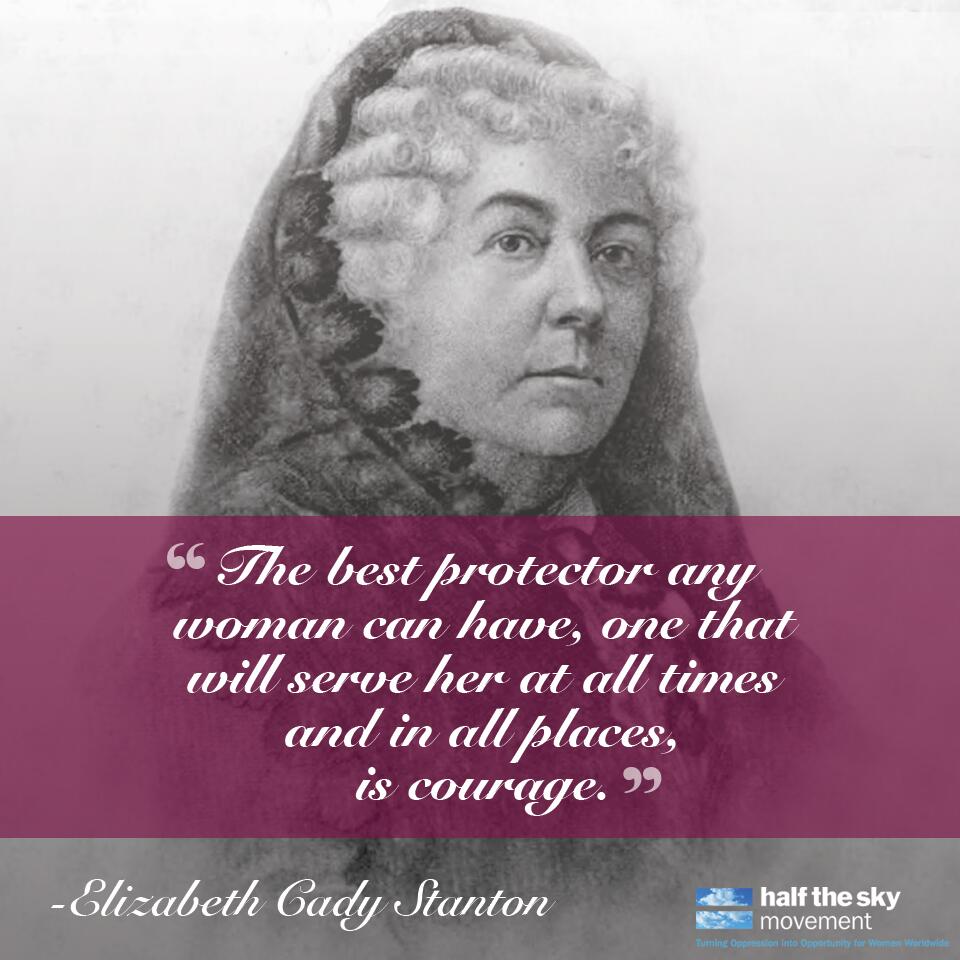
So often the contributions of women are not appreciated or remembered.  That's why I really loved this post on the LDS history website about Mary Whitmer.  I can't really tell why it moved me to tears, but I loved knowing about her contribution that literally held things together.  175 years ago today, not too many years after Mary Whitmer hosted Joseph Smith, Elizabeth Cady Stanton and Lucretia Mott essentially started the women's movement in America by holding a convention on equal rights in Seneca Falls, New York.  Things have gotten much better for women since then, but I'm grateful for the contributions of the Marys and the Elizabeths to get us where we are.

Elizabeth Cady Stanton is one of my heroines.  In honor of the anniversary of the start of the Seneca Falls Convention today, I'll share this quote that I got from Twitter:


Thanks, Liz!  Thanks, Mary!

Monday, July 15, 2013

Criminal Tragedy

Per the most reliable source available to me as a non-lawyer (Wikipedia), second degree murder is a murder that is not premeditated.  Murder is further defined as the unlawful intentional killing of another human being.  However, in the US we have chosen to add a secondary category of "manslaughter" which, when referring to "voluntary manslaughter" is killing without premeditation.  The biggest news story this weekend was the Zimmerman trial verdict.  George Zimmerman shot and killed Trayvon Martin on February 26, 2012 in Sanford, Florida.  Zimmerman had called 911 and was told to NOT follow the suspicious person he reported to police.  Martin was unarmed.  These facts are not in dispute.  What was hotly contested over the course of the trial was whether Zimmerman was guilty of murder or manslaughter, or whether he acted in self-defense.

In the US, we have laws requiring that a suspect's guilt be proved beyond a reasonable doubt.  In my mind, there's no doubt that George Zimmerman was an idiot.  And while I can't judge his motivations, it's certainly possible that the only reason Zimmerman viewed Martin as a threat was the fact that Martin was black and wore a hoodie (and IF that's the case, it's despicable).  But to focus on this one case overlooks a larger important point.  Since the events of February 26, 2012, over 30,000 people in the U.S. have died at the hands of a gun.*  That's an average of 3 per hour.  The rate of death in the U.S. by gun is exponentially higher than every other industrialized nation.  In the category of industrialized nations, America's gun death rate of 10.6 per 100,000 is followed by Finland at 4.6 - less than half!  It's no coincidence that the U.S. has 88.9 guns per 100 people.  The next closest country, India, has FOUR per person.

It's a tragedy that Trayvon Martin is dead, but it is CRIMINAL that we are not doing anything to reduce gun violence in this country.  George Zimmerman successfully argued self-defense and was declared not guilty.  But whether or not he spent time in jail, the truth is that gun violence is a preventable problem.  We can blame politics, blame the media, or blame George Zimmerman,  but it's a colossal problem that is bigger than any one case.  We need to explore "stand your ground" laws, "concealed carry" gun laws, and other laws on the books that contribute to this problem.  We need to examine our hearts, and banish any latent racism we find therein.  It's going to take all of us.


*We don't have published statistics yet for 2012 or 2013, but as over 30,000 people were killed with guns in 2010 and 2011, I feel like this is a rational assumption.

Monday, July 8, 2013

Charity for the Divine and the Democratic

Presidential candidates have (to seem) to be normal.  There's the famous test of ordinariness that's encapsulated in the question "Do you want to have a beer with..." this person?  (One more reason Romney couldn't be President...*zing*).  In a way, this is a uniquely American idea.  The theory presumes that a ruler is subject to the people, and is one of them.  He (or she...someday!) is a citizen.  In contrast, the Divine Right of Kings to rule emanates from the Gods, and in some cultures, the emperor or king is a descendant of the Gods.

Similar to democratic thought, the prophet of the Mormon church has always been considered an ordinary church member.  Mormons have a "lay priesthood" which means that ordinary church members lead services, administer the church, and run things on a day to day basis.  There aren't professional Mormon priests (although some people do work full time for the church and are paid to do so).

Yet, even though we think Presidents and Prophets as men of the people, we rarely get to meet with them.  We "know" them only through the carefully filtered glimpses we see in the media or in second- or third- hand reports.  I remember when I visited General Conference (the twice-yearly Mormon conference where the Mormon prophet speaks to all Mormons via satellite).  I stood in the Salt Lake City Tabernacle as an 8 year old, firmly convinced that if I could shake the hand of one of the Apostles, I would know the church is true.  It's childish, but I think it's a manifestation of a genuine desire to KNOW our leaders.

That's why both of these recent moments resonated:

President Obama's Fist Bump after the State of the Union

Elder David Bednar and Elder L. Tom Perry (two Mormon Apostles) Fist Bump after General Conference
It's just a simple gesture.  But it signifies that these men are JUST. LIKE. US.  They're human, not divine.  We can relate to them and somehow, we are more willing to listen to what they have to say.  

One of my favorite definitions of the word "charity" is that "Charity is accepting someone’s differences, weaknesses, and shortcomings; having patience with someone who has let us down; or resisting the impulse to become offended when someone doesn’t handle something the way we might have hoped. Charity is refusing to take advantage of another’s weakness and being willing to forgive someone who has hurt us. Charity is expecting the best of each other."*  I LOVE that - "Charity is expecting the best in each other"!  That's a very divinely democratic idea - hopefully charity can extend to those we believe are divinely inspirited to lead us, as well as to those who are democratically elected to do so.  

* From Marvin J. Ashton's Talk, "The Tongue Can Be a Sharp Sword," April 1992 General Conference

Monday, July 1, 2013

Definitionally Speaking

What does it mean to be a patriot? To be a traitor? Both words have recently been applied to Edward Snowden, a former government contractor who recently revealed some of the NSA's spying secrets. To some, Snowden is a truly patriotic and courageous individual who brooked personal risk of prosecution to bring nefarious (and Anti-American!) policies to light. To others, Snowden is a traitorous scumbag who betrayed his country by revealing classified information.

Are the definitions of the words "traitor" and "patriot" relative or do they have absolute meanings?  Take one example from the American revolution, Benedict Arnold.  Arnold was viewed as a traitor to the cause of American freedom because he sold out the American army he was supposed to be serving, while to British he was a true patriot in serving the just cause of Great Britain in fighting the rebels.  At the time, how you viewed Benedict Arnold probably depended on which side of the war you were on, not so much an absolute definition of patriot or traitor.

July 4th is a time when we celebrate our "independence" from Great Britain, and we include in that celebration a litany of founding fathers.  We tend to lump (dump?) all these individuals into one broad category of awesomeness and pure righteousness, but we forget that among them were Benedict Arnolds and even lukewarm "patriots" who may not have been 100% behind the war.  There was disagreement even among the signers of the Declaration of Independence and Constitution over the form and direction the new nation should take. To me, remembering the humanness of these people is very American. 

America can tolerate dissent and debate, and should not be afraid of open disagreement among Americans.  The very fact that both those who despise and those who lionize Edward Snowden can each claim the mantle of patriotism is a quintessentially American idea.  America does not mean that we all have to think alike or agree on what it means to be a patriot.  A patriot is someone who takes the ideas of America and applies them in their own way, towards a better community and a better land.  America is about building an open society that can survive Edward Snowden's revelations, absorb the knowledge, and become stronger through a discussion of whether this is something we want to do as a nation.  It's important to have that conversation, because its an American conversation to have.  Too often we claim exclusivity in our Americanism, saying that we are the "Real America" or that the other side is traitorous.  Instead of throwing labels, let's listen to the other side and actually have an adult conversation about this NSA program, its pros and cons, and whether it is justified. 

(And yes, it's ironic that I'm using a Russian song in my discussion about American dissent)

Monday, June 24, 2013

I Think I'll Try (Defying Gravity)


It should be pretty clear that I'm not a risk taker.  After all, I'm an accountant - kind of the definition of lame and "safe career choice."  But sometimes you have to try to defy even the laws of nature.  It's why I found Nick Wallenda's walk across the Grand Canyon foolhardy, yet oddly inspiring.  He's crazy, yet I admire him for taking chances. It takes bravery - you don't have guarantees of the outcome and he literally walked without a safety net.  I could not do that, but I need to start letting go of fear and taking chances - otherwise I feel like my life will be wasted.  Time to try defying gravity!

"Defying Gravity" from the musical Wicked

Tuesday, June 11, 2013

If a Girl Isn't Pretty

Have you ever heard of Fanny Brice?  She was a vaudeville star in the early 20th century.  Later, her life story was made into a musical and movie called "Funny Girl."  One of the songs in that musical, "If A Girl Isn't Pretty," reminded me recently of a feminist tic that I have.  I dislike double standards for men and women.  One that annoys me most is the standard set for men and women with regard to outward appearance.

Barbara Streisand, "If A Girl Isn't Pretty"

Often, women are expected to gussy themselves up in makeup, nice clothes, curled/styled hair, high uncomfortable shoes, and other expensive accessories.*  On the other hand, men can basically wash their hair and roll out of bed, put on anything, and it's totally fine.  Men aren't expected to wear makeup to cover up their real face or endure discomfort in the name of fashion, but somehow these things are perfectly acceptable to require of women, and the women who don't participate are viewed as ugly and unnatural.**

I was reminded of this double standard when listening to a version of another favorite Broadway song.  The relevant portion of original lyrics are reproduced below - this is a song composed by George Gershwin and is typically sung by a woman.  Keep your eye on the bolded lyrics describing the physical features of the woman's future love.

There's a somebody I'm longing to see
I hope that he turns out to be
Someone to watch over me

I'm a little lamb who's lost in a wood
I know I could always be good
To one who'll watch over me

Although he may not be the man some girls think of
As handsome
, to my heart
He carries the key

So, let's review the key elements here: a woman is looking for a man to complete her.  Even though he's not handsome, that's okay - he's a good guy who's going to take care of her (we can get into the other stereotypes of this song later - women needing men to complete them, I know, I know - we're focusing on one double standard at a time).  Now, let's look at the same lyrics when the song is sung by a MAN:

There's a somebody I'm longing to see
I hope that she turns out to be
Someone to watch over me

I'm a little lamb who's lost in a wood
I know I could always be good
To one who'll watch over me

Although I may not be the man some girls think of
As handsome,
to my heart
She carries the key

Recap: in this version, sung by a man, he's looking for a woman to complete him.  So far, we are simply reversing the lyrics sung by a woman.  BUT, notice he is *not* saying the reciprocal of the female version in that last stanza, which would be "Although she may not be the girl some men think of as handsome" - instead, the song leaves the guy as the unhandsome one, thus implying that it would be unacceptable for the woman not to be pretty.

Now, I'm probably reading wayyyyy too much into a simple song, but it's symptomatic of a culture that prizes only one type of beauty - the super skinny model kind.  As someone who admittedly doesn't fit that model of beauty, I find it disturbing that in small and big ways we reinforce the message that women must be beautiful (as the magazines define it) in order to be admired or worth pursuing.  How do we fix it?  Can we? Maybe we can fix it by admiring women for something other than physical beauty.  So, look for women who are courageous, honest, happy, or kind, and praise them for that inner strength and beauty.  It's time to look beyond our cultural blinders!  I hope we can still appreciate a great melody, right?  Especially when it's sung by a woman with a beautiful singing voice:

Ella Fitzgerald, "Someone to Watch Over Me"

*Note that I'm NOT saying that these things (makeup, high heels, nice clothes) are wrong - if you enjoy them, that's great!  I just object to having them be THE standard of beauty for women, and reinforcing the idea that if women choose other things, her natural look is somehow less beautiful.
**And yes, some of this is probably sour grapes, because I still have never figured out how to walk in heels or apply eye makeup successfully.