A Bit 'o Random Musings on Politics, Religion, and Anything Else That Passes Through My Crazy Head

Friday, July 3, 2015

(Un) American Heroes

I read an article many years ago (either in the Bloggernacle or maybe BYU's Political Review) which talked about the futility of comparing the society in the Book of Mormon to our modern day politics because of the vast differences in our society. While I didn't agree with all of it, it's certainly a valid point that the largely agrarian and tribal society in the Book of Mormon is vastly different than our industrialized democratic republic here in the U.S.

One example of this is Captain Moroni, who is a hero in the Book of Mormon's war chapters. Mormon, the editor of the Book of Mormon, shows Captain Moroni some serious love when he writes: "Yea, verily, verily I say unto you, if all men had been, and were, and ever would be, like unto Moroni, behold, the very powers of hell would have been shaken forever; yea, the devil would never have power over the hearts of the children of men" (Alma 48:17). Mormon obviously thought Moroni was a hero, and portrayed him as such. With all that, it's no surprise that Mormon named his son Moroni, and generations of church members have looked to Captain Moroni as the paragon of virtue and righteousness.

But if we look closely at the record, Captain Moroni is in some ways a dangerous example to promote when we talk about current political affairs. He executed people who didn't agree with him (Alma 46:34-35, 51:14-20). He also had a vast impatience with anyone who didn't do exactly what he wanted when he wanted it (see Alma 60). In many ways, Captain Moroni saw the world in very black and white terms, which is useful if you're fighting an enemy that wants to kill you and drink your blood, but isn't very useful if you're trying to take part in a democracy where people will disagree with you.

Looking at modern day politics through Captain Moroni's lenses will cause us to see people as traitors if they disagree with us about political affairs. Captain Moroni threatened to lead an insurrection if the government didn't do what he wanted (Alma 60:27), even if the majority will disagreed with his policies, all the while claiming ironically "... I seek not for power, but to pull it down." (Alma 60:36). By seeking to "pull down" those leaders who didn't agree with his worldview, Captain Moroni was like an ancient version of Douglas MacArthur during the Korean war - critical of government policy and seeking to impose his military views on the political leaders of his time.

In America we believe in a secular society where military power is controlled by the civilian branches of government. We also separate government and religious action in order to allow all mankind to "...worship how, where, or what they may" (11th Article of Faith). These concepts would be foreign to Moroni and many in the Book of Mormon, who viewed government and religion as necessarily intertwined, and would likely not appreciated the checks and balances of the American political system. As I've stated before here, and for the reasons laid out much more eloquently here, I believe it's a good thing that America has religious freedom while also strictly separating church and state.

Ultimately, I believe the Book of Mormon teaches us very valuable principles. These principles can be applied differently by different people, and it's only right that in a society based on freedom we argue and debate the priority of various principles and how they apply to various situations. But to use a military leader from thousands of years ago as a political paragon ignores some of the more troubling aspects of his leadership. Hero worship is never a good thing, because humans are fallible and imperfect beings. And what I love about American government is that it recognizes this, and builds in checks and balances to guard against the imperfections in our temperaments.

We're still building America, as this one supremely idealistic scene from the TV show The West Wing reminds us:

Jeff Breckenridge: You got a dollar?
Josh Lyman: Yeah.
Jeff Breckenridge: Take it out. Look at the back. The seal, the pyramid, it's unfinished, with the eye of God looking over it, and the words annuit coeptis - he, god, favors our undertaking. The seal is meant to be unfinished, because this country's meant to be unfinished. We're meant to keep doing better. We're meant to keep discussing and debating. And, we're meant to read books by great historical scholars and then talk about them...
So, study Captain Moroni - be bold and valiant like he was, that's a good thing. But realize that some of his values were un-American, even if he is a hero, and keep building the America you want to see, with empathy for those who disagree and a respect for our constitutional system which guards your liberties, my liberties, and the liberties of all who live here.

Happy Independence Day!


Sunday, May 31, 2015

Grinding the Faces of the Poor, and Other American Political Bloodsports

What mean ye that ye beat my people to pieces, and grind the 
faces of the poor? saith the Lord God of Hosts. (Isaiah 3:15)

Nothing makes me angrier than politicians who disparage poor people. It's an easy target, because poor people don't often vote, protest, or communicate with their elected officials. It's a simple way to show you are using government funds sparingly - making sure "undeserving" poor aren't using welfare funds to buy lobster or go a cruise.

The latest example is Kansas, which has recently enacted a law limiting the amount of cash which welfare recipients can withdraw from ATMs and forbidding welfare recipients from spending money on "exotic" entertainment, swimming pools, tattoos, or movies. Even more states are moving to drug test welfare recipients, even though the evidence shows these groups are not more likely to abuse drugs than the population at large. Similarly, government assistance with housing costs disproportionately goes to the mortgage interest deduction for the upper/middle class instead of housing vouchers for those in a lower socioeconomic status.

So, here are my reasons why we need to stop abusing the poor for using government benefits:
1) People using government benefits don't actually spend a large portion of their money on extravagances. Their spending habits aren't actually all that different from the rich or the middle class.
2) There's a myth that the poor are sponging off the rest of us taxpayers, but the truth is that poor people pay taxes too - in some cases more taxes than the rich. Further, government benefits do not allow you to live the high life, as reading this article will show you, people receiving welfare are hardly rich, and often only need temporary assistance to get through the lean times. They're you and me, not some "second class" of citizens who we can mock and disparage.
3) We all receive government benefits, and that doesn't give the government the right to tell us how to live our lives. Should the hedge fund manager be required to stop visiting a strip joint because he claims the mortgage interest deduction on his tax return? (In some cases for both his primary residence and vacation home?) What about the student who receives a low interest loan yet gets a tattoo? These are government benefits, just like food stamps, yet apparently it's okay for Kansas to tell welfare recipients how to spend their money, or for states to invade these people's privacy through requiring drug testing, but the government makes no similar provisions for the other benefactors of government largess.

Isaiah uses strong imagery to condemn those who trample the poor - they "grind their faces" - can you imagine if someone literally did that?  That's assault! Yet it's okay for politicians to condemn these people and figuratively grind their faces into the dust. This is political bloodsport, and IT IS WRONG. It makes me so very sad to think that this is acceptable behavior by politicians, who should be seeking to help these people lift themselves out of poverty, instead of stereotyping them and making life more difficult for them.


Wednesday, April 15, 2015

10 Tax Laughs for Tax Day

I've been saving up all the amusing things I read or hear about taxes, and, in honor of Tax Day today, will share them with you.

#10 - This comic.
All theirs #irs #tax #humor

#9 - A Ron Swanson Quote.

Political Humor There is only one bad word, taxes. Any other word that is good enough for sailors is good enough for you.

#8 - This Tweet on extensions.

#7 - David Letterman Tax Tips.


#6 - This Comic.
tax humor | The Reel News: Tax Jokes & Humorous IRS Quotes This time, you should consider earning from the IRS! Learn to earn from Tax Liens Investing with Ted Thomas. http://www.tedthomas.com #Tax #Humour #Jokes

#5 - This e-card.


#4 - NPR's Marketplace investigative journalism on little known tax deductions.

#3 - The Onion's investigative journalism on the most overlooked tax credits.

#2 - John Oliver's (and Michael Bolton's) Defense of The IRS - it's a much maligned agency that's just trying to do its job.


#1 - The poem below, which captures the frustrations of tax season for tax preparers like me.


Memo Home Re: Tax Season
By Keith Mattson

I’m working late, I won’t be home;
Don’t try to reach me on the phone.
Don’t expect me home for dinner.
Don’t expect me home this winter.
Don’t even try to use your pull.
Don’t talk to me or shoot the bull.
I don’t want you to think me cruel,
But until May, my slate is full.
Just tell me what you spend and earn;
I’ll put it in a tax return.
(I hope that you will never learn
You’re just another file to churn.)
I’ve got files on my floor,
And on my chairs and desk are more.
I’ve got them coming in the door.
That’s all I do — I keep the score.
So far this year, the feds are winning,
With clients behind before beginning.
Their tax returns show “Balance due;”
Their checkbooks show a scarlet hue.
Their life is on a downward trend,
And then they ask, “Can we extend?”
I pause a bit … I say, “Absurd!
Where did you learn that awful word?”
But it’s too late for rhyme or reason;
They’ve just extended busy season!
And so, my dear, I’m warning you,
Just when we thought the season through:
I’m working late, I won’t be home;
Don’t try to reach me on the phone.
I’ll try to write or maybe call.
I hope to be home late this fall.

Sunday, March 29, 2015

Suffragists Unite!

Let's start with what you already know about me: I'm a political nerd, feminist, and Mormon. All of these things motivated me to host a party in March with a theme of Women's History. Because I'm a political nerd, it focused on the struggle for women's suffrage. Because I'm a feminist, it focused on the women who fought for this right. Because I'm a Mormon, it had a food theme and cheesy decorations. Not wanting you, my online friends, to be left out of the fun, I decided to blog about it, so that you could host your very own suffrage party, should you desire to!

Any good party should have good food, and we had that in abundance. Our food theme was green, purple, and white.  Why, you ask?  Good question! These colors were some of the colors associated with women's suffrage. Green symbolized hope, purple represented dignity, and white stood for purity. So, we had cabbage salad (with purple and green/white cabbage), spinach and artichoke dip, smashed avocado, cucumber rolls with white cheese, peanut butter pie (dyed green and purple, of course), green jello with a white something and blackberries (it tasted much better than my description), and blackberry smoothies. My contribution was a cake which recreated a pennant on Wikipedia:

Next, decorations. These were not as pretty as I would have liked, but I ran out of time to make them beautiful so they were merely printouts and some black and white decorations done on butcher paper with a sharpie marker. We had an opportunity to take a "Suffrage Selfie" as you came in the front door:


Also at the front door were short booklets I made which celebrated the life of women suffragists of all different stripes, so that everyone could learn about an amazing American woman.


Our table centerpiece featured doll suffragettes, holding actual signs from the movement. 


We also had a wall showing "pro" and "con" documents/pictures from the early 1900's. Naturally, my favorite argument against women's suffrage was that it would lead to higher taxes.


There was also a large banner, recreating one of the banners that the Silent Sentinels held while picketing the White House during World War I.


The main event, however, was watching the movie "Iron Jawed Angels," which follows the stories of Alice Paul and Lucy Burns, two of the radicals who founded the National Women's Party, picketed the White House, and were eventually thrown in jail, where they staged a hunger strike. It's an intense and fascinating movie, and if you haven't seen it, I highly recommend viewing and/or purchasing it. While it's not rated, there's probably a few moments which are PG-13 in content, FYI.

For the week before the party, I spent time reading about women's suffrage and the women's rights movement of the late 1800's and early 1900's. I learned so much about courageous women who stood up and spoke for what they thought was right. These women are heroines and examples to me. One of the books I read noted that all too often, history books say that "women were granted the right to vote" - a passive sentence that diminishes the decades of struggle and thousands of women who devoted countless hours to the cause. I encourage you to learn more about them and their struggle for ALL OF US. Too often, women's history is forgotten or dismissed, but these women made our country and world a better place. It's up to us to remember them!

Some more resources for planning your Suffrage Party (let's get #SuffrageSelfie trending on twitter, eh?):
Smithsonian Folkways Album Songs of the Suffragettes (Recorded by Elizabeth Knight)
Monica Grabin's Album HerStory - American Women in Song
I've posted the handouts I used here, along with the decorations here (note: copyright violations and factual inaccuracies are possible)
Your Local Library! (if it isn't chock full of books about Suffragettes, stage a protest)
Someone has helpfully uploaded the entire PBS Documentary One Woman One Vote to YouTube:

If you do host a suffrage party, post about your experience in the comments!  Or, feel free to link to stories about women who inspire you.

(Also, if you like this post, you may also enjoy this one and this one).

Tuesday, March 17, 2015

Women's History Month

March is a great month, and not just because it moves us closer to my release from busy-ness on April 15th. March is chock full of women-y things that make my feminist heart rejoice.  In the U.S., March is Women's History Month, where we remember the contributions of women in shaping America. March 8 is International Women's Day, which I first celebrated on my mission, and I love because it reminds me of all the strong, capable, spiritual women I met in Russia. March 17th brings the anniversary of the founding of the Relief Society, an organization I love and believe has so much potential to influence lives for good. And this year, the LDS church is holding its annual Women's meeting on March 28th.

The first Relief Society President, Emma Hale Smith, stated that "The object of the Society … is to seek out and relieve the distressed—that each member should be ambitious to do good." I really like that - I think that all of us can be "ambitious to do good." In celebration of all that is wonderful about women, I wanted to get the voices of more LDS women on Pinterest. Pinterest is full of inspiring quotes by male LDS leaders, but when I search for quotes by LDS women I often come up empty. So, to rectify that, I've created "pinnable" images for quotes from every general president of the Relief Society over the last 173 years - there have been 16 presidents so far.

Pin away, I say! Also, feel free to add your own favorite quotes from our Relief Society leaders in the comments below, or use Recitethis.com to create your own pinnable images.

From President Burton's 2014 address, "Wanted: Hands and Hearts to Hasten the Work"

From President Beck's "And Upon the Handmaids in those Days Will I Pour Out My Spirit"


From one of my all time favorites, "Personal Ministry: Sacred and Precious"
President Mary Ellen Wood Smoot, "Steadfast and Immovable"
President Elaine Low Jack, "Seek and Ye Shall Find"
President Barbara Winder, quoted in the book Faith, Hope, and Charity:
Inspiration from the Lives of the General Relief Society Presidents
"Ideals are stars to steer by; they are not sticks to beat ourselves with."
--Barbara B. Smith
From "A Conversation with Sister Barbara B. Smith" (I stole this one from Pinterest)
President Belle Smith Spafford, quoted in Chapter 6 of Daughters in My Kingdom
President Amy Brown Lyman, quoted in her official Bio on the church's website
President Louise Yates Robison, quoted in her official bio on the Church's website
President Clarissa Smith Williams, quoted in Chapter 5 of Daughters in My Kingdom

President Emmeline Blanche Woodward Harris Whitney Wells 
President Bathsheba Wilson Smith, quoted by Sheri Dew in "Something Extraordinary"
President Zina Diantha Huntington Young, quoted in "Great Grandmother Zina: A More Personal Portrait"

President Eliza Roxcy Snow's Poem "O My Father," currently in the LDS Hymnal as Hymn #292


President Emma Hale Smith, quoted in her official bio on the Church's website


Sunday, February 8, 2015

Shoulda Woulda Coulda (Or, Unrighteous Indignation)

Approximately 76.8% of my blog posts are inspired by things I should have said. You know the conversations - where everyone around you is of one mind on a given topic, but you think differently.  (For the record, this applies to both political conversations with my conservative friends and religious conversations with my friends of other faiths or no faith). Driving home from those conversations, I usually think up great retorts and zinging one liners to prove how wrong those people were/are. Later, after calming down and being less angry, I think of probing questions to ask that may have provoked people to think about their position and see things from the other side. Usually I simply regret that none of this occurred to me at the time of the conversation, because it's far too late now to come back and re-discuss the topic.

"Happiness is...a witty reply that totally wins the argument"
So blogging is basically my coward's way out. I get all the satisfaction of responding in just the way I like, without any of the dissatisfaction of actually having to be the voice of an unpopular minority in the conversation.  Yet sometimes I wonder, am I shortchanging both myself and my friends by doing this? An anonymous rant on the internet may be emotionally satisfying in the moment, but it's not really helping in the long term. Would it be better to speak up, however in-artfully and incoherently, and risk that we might both learn something? Maybe there are others who are silently thinking the same thing? Perhaps if I spoke, they might also be able to speak.

How do I get over my cowardice? There's a verse in the Book of Mormon, which states "Use boldness, but not overbearance; and also see that you bridle all your passions, that ye may be filled with love..." (Alma 38:12). I think this is applicable here - a balance between "boldness" or courage in your beliefs, but also without being overbearing, which the dictionary describes as "unpleasantly or arrogantly domineering." Too often, I am "righteously indignant" (especially in the zinger phase) that my friends are so wrong or narrow minded, without remembering that it's just as likely that I am wrong or narrow minded in my thinking and without remembering to love my friends. By blogging about it, I preclude responses to my thoughts that might benefit both me and my friends.

It's helpful context to know that the Book of Mormon verse above is Alma's advice to his son. Alma states further "Do not say: O God, I thank thee that we are better than our brethren; but rather say: O Lord, forgive my unworthiness, and remember my brethren in mercy--yea, acknowledge your unworthiness before God at all times" (Alma 38:14). Too often, I'm silently patting myself on my back with righteous indignation which is anything but righteous. I need to work on remembering my friends in mercy, instead of the shoulda, woulda, coulda approach of trying to zing them with my take-downs. Even if they're wrong - and let's face it, sometimes they are. But sometimes I need to be filled with love instead of anger.

Saturday, January 31, 2015

It's Important to Be [Kind]

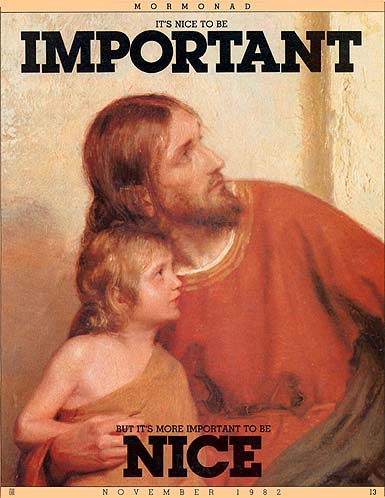
While watching the recent movie adaptation of "Into the Woods" (which was AMAZING, by the way), two lines stood out to me and I have been thinking about them ever since. When Little Red Riding Hood is saved from the Wolf, she sings a song about what she's learned, stating: "Nice is different than good." Similarly, the Witch accuses some of the other characters when they try to save Jack from the Giant: "You're so nice, you're not good, you're not bad, you're just nice." We don't typically use "nice" in a pejorative sense, but the Witch and Little Red Riding Hood seem to. Being Mormon, "nice" is kind of ingrained in us. They got me while I was young with this MormonAd:

"It's nice to be important, but it's more important to be nice" (see footnote 1)

But do we really want people to be "nice"?  Nice is different than actual charity, kindness, or empathy. Nice is a thin veneer of an outward show of respect that may or may not be truly felt. Nice is basically politeness. As Little Red Riding Hood notes, NICE is different than GOOD.  This is expressed by Chieko Okazaki, one of my favorite LDS leaders:

When the apostle Paul says, “Charity suffereth long, and is kind” (1 Corinthians 13:4), he’s not just talking about being nice and wearing smiley-face buttons. He’s talking about the core of the disciple’s life. Kindness without love is not kindness at all. It’s patronage, it’s condescension, it’s smugness and superiority. If you have been the recipient of this species of “kindness,” you know that you would much rather do without it. But with love, kindness is refreshment and rejoicing. It strengthens bonds and creates new ones. And it’s a tough, patient virtue, not a frilly, fluffy one. (Sanctuary, 75)

When we think about politics I think we sometimes want our politicians to be "nice" to each other. We want them to avoid yelling, to show that outward deference to another's point of view. But I think we may actually get condescension, smugness, or superiority to dominate our political discourse when we expect this type of behavior from our elected leaders. What we should be seeking is politicians and leaders who will risk empathy and true charity towards those who disagree with them. 

One of my friends worked for a Senator and I remember her telling me that they would get nasty phone calls from constituents when the Senator was simply talking to members of the opposite party on the Senate floor and it was on C-SPAN. She noted that it had a chilling effect on relationships between Senators. If we can't even deal with our elected officials being nice to each other, I don't know how we would handle them compromising and seeing things from the point of view of the "other"! 

Nick Kristof, a New York Times opinion columnist recently wrote about a high school friend of his who had died - I thought he made some good points about how we need empathy for those who suffer, instead of judging them. Unfortunately, reading through the comments just proved Mr. Kristof's point - many commenters did not stop to consider that they could have been in this man's place - they hadn't walked a mile in his shoes, but were perfectly willing to judge him (and by extension anyone receiving government help). Where is our empathy? Where is our compassion and kindness for those who struggle? Where is our understanding for those who disagree with our politics? I don't have answers to these questions, but I know that part of fixing our broken political system (and world) is breaking through niceness and getting to true charity for others. I just wish I knew how to do it.


Footnote 1: Note that I could go out on a whole different (feminist) rant about this MormonAd. I think it has a subtext that encourages us to be doormats and downplay our own importance. For another time...